
"The UI Bakery platform offers a cost-effective approach to creating applications. With UI Bakery, you can achieve your app development goals without breaking the bank."
Dominik Amann @EHG
4 types of operations
Adds a new record to a database. In RDBMS, this inserts a new row in a table. In NoSQL, a new document or item is added.
Retrieves records based on search criteria. It can return all records or specific fields.
Modifies existing records. Ensures consistency when updating multiple fields in a record.
Removes records. A hard delete erases the data, while a soft delete flags it but keeps it stored.
WHAT is it
Any company tracking data (such as user accounts, payment data, or other records) requires systems that provide persistent storage, which is often presented as a database. CRUD consists of four operations teams use to implement persistent storage applications like relational databases. Operations such as security control, transaction control, access, and permission, and performance optimization are all based on CRUD.
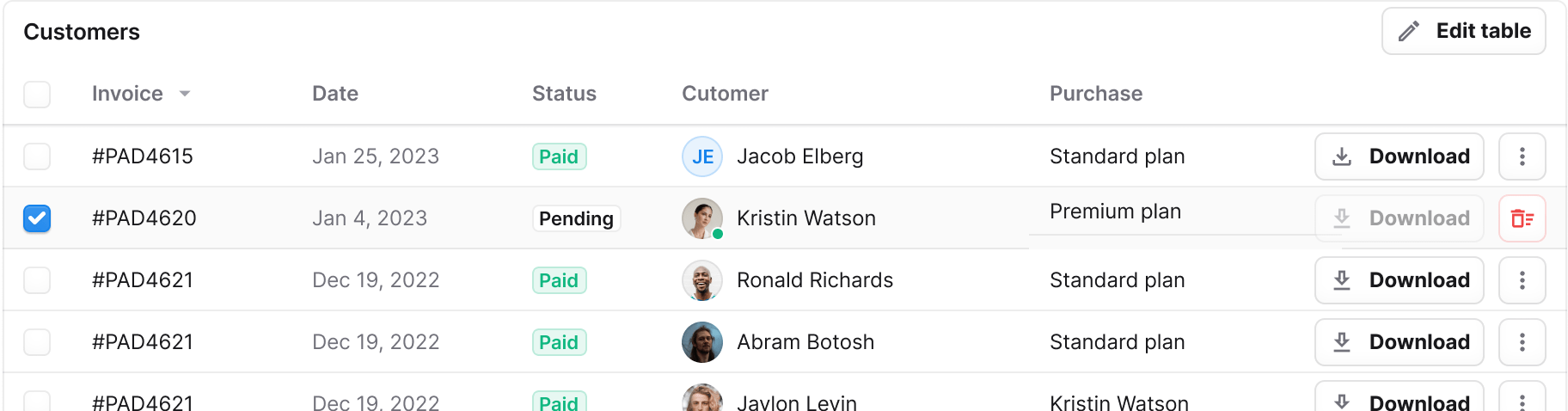
CRUD (Create, Read, Update, Delete) is essential for database interactions. It enables data storage and management. REST APIs, widely used in web development, are built on CRUD principles. CRUD is crucial not just for developers but also for users—actions like registering, creating content, and saving bookmarks all rely on CRUD operations.

 Validation
Proper input validation is essential to prevent SQL injection, cross-site scripting (XSS), and data corruption, so it's best to utilize strict schema validation for structured databases.
 Secure
Protect database access by implementing role-based access control (RBAC) and attribute-based access control (ABAC), ensuring API endpoints handling CRUD operations are secured with OAuth 2.0, JWT, or API key-based authentication.
 Optimize
Use database indexing on frequently queried fields to improve search efficiency and implement query optimization techniques like denormalization and materialized views when necessary.
 Error handling
Implement structured error handling using try-catch blocks and centralized logging to capture exceptions and use ACID-compliant transactions for relational databases and eventual consistency mechanisms for NoSQL solutions to ensure data integrity.
 Soft deleting
Instead of permanently deleting records, implement soft delete mechanisms by adding an is_deleted flag or moving data to an archival table as helps with audit trails, compliance with data regulations like GDPR and CCPA, and recovery from accidental deletions.
The UI Bakery platform offers a cost-effective approach to creating applications. With UI Bakery, you can achieve your app development goals without breaking the bank.
Check all stories
