

Top 9 Appsmith alternative platforms to consider in 2025
Appsmith stands out as an open source internal tool builder renowned for its efficiency in crafting internal apps that can’t be bought off the shelf, leading to significant cost savings. However, if you’re reading this, chances are you’d like to learn more about Appsmith alternatives for whatever reason.
This article offers a thorough guide for various low-code tools alternative to Appsmith, delving into their features, pricing, and overall functionality while maintaining an objective standpoint. While we hold the belief that UI Bakery serves as the main replacement to Appsmith, particularly suitable for SMBs and SMEs, our goal is to provide a detailed analysis of Appsmith competitors in 2025.
Try UI Bakery| Rank | Company | Headquarters | Product Suite | AI Capabilities | Funding |
|---|---|---|---|---|---|
#1 | Appsmith | 🇮🇳 India | Apps | None | VC Backed |
#2 | UI Bakery | 🇪🇺 EU | Apps, Workflows, Scheduled Jobs | AI Development Assistant, OpenAI API Connection | Bootstrapped |
#3 | Retool | 🇺🇸 USA | Apps, Workflows, Scheduled Jobs | AI Development Assistant, OpenAI API Connection | VC Backed |
#4 | Budibase | 🇬🇧 UK | Apps | OpenAI API Connection | VC Backed |
#5 | DronaHQ | 🇮🇳 India | Apps, Workflows, Scheduled Jobs | None | VC Backed |
#6 | Superblocks | 🇺🇸 USA | Apps, Workflows, Scheduled Jobs | OpenAI API Connection | VC Backed |
#7 | ToolJet | 🇺🇸 USA | Apps, Workflows, Scheduled Jobs | None | VC Backed |
#8 | Jet Admin | 🇺🇸 USA | Apps, Workflows, Scheduled Jobs | None | VC Backed |
#9 | Internal.io Shut down | 🇺🇸 USA | Apps, Scheduled Jobs | None | VC Backed |
#10 | Airplane.dev Shut down | 🇺🇸 USA | Apps, Workflows, Pipelines | AI coding assistant | VC Backed |
Appsmith

Appsmith, recognized as an open-source internal tooling platform, has established itself as a robust low-code development platform, aiding businesses in optimizing their application development processes. Nonetheless, it's advisable to delve into Appsmith alternative options to discover the ideal solution that aligns with your distinct requirements.
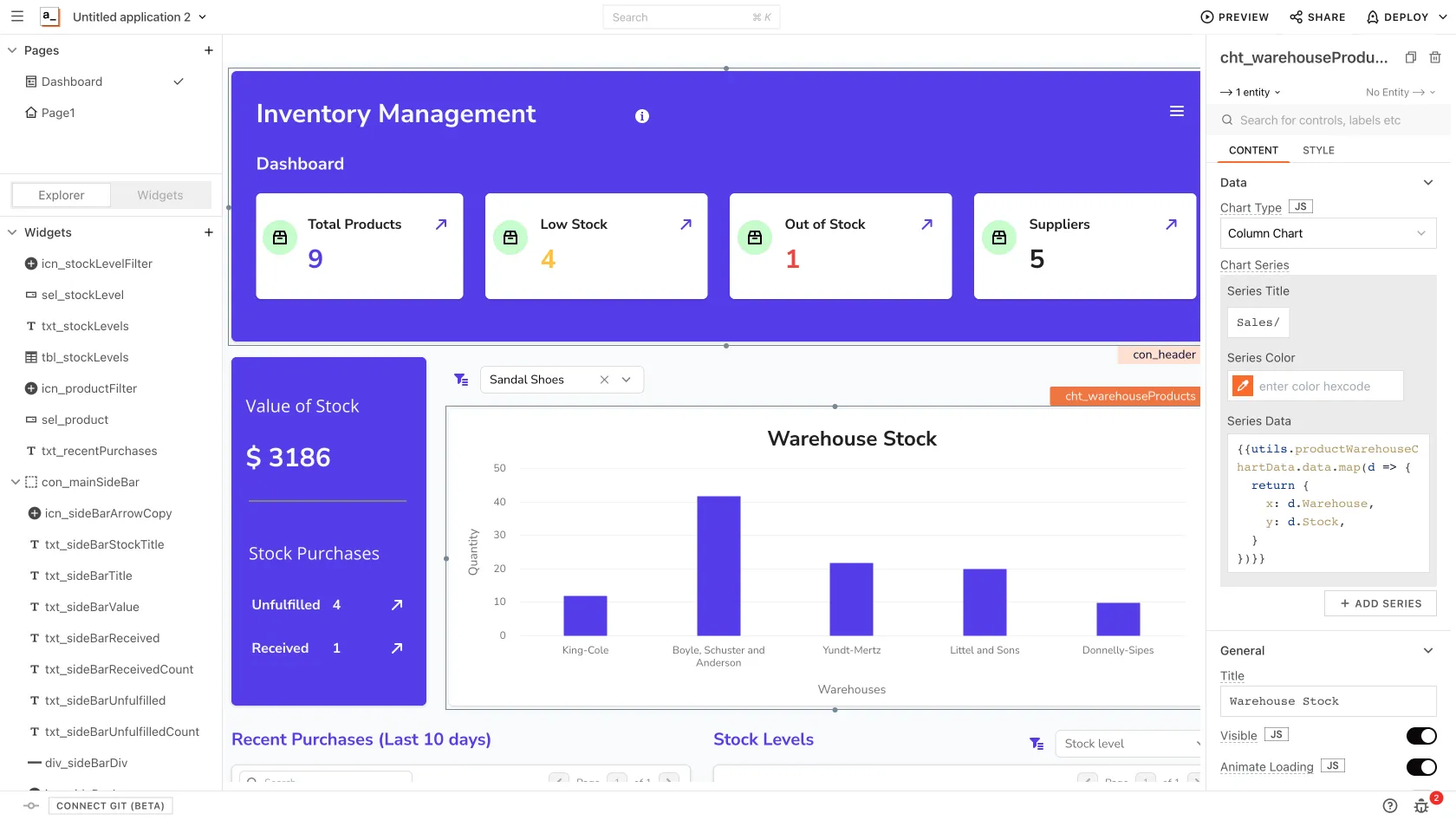
Open-source, which means that the other developers can potentially audit the code they write.
Large community on GitHub.
Autolayout feature which can be useful for certain cases when building responsive apps.
The pricing model isn't clear. It's difficult to estimate the total cost of the product, especially as it's based on hourly or per-user rates.
UI builder might be buggy sometimes.
Only sample databases. No embedded database available.
Not as many embedded components as UI Bakery has.
Not as many native data source connections, though has all most commonly used.
No Workflows/Automation feature.
Environments only for data sources.
Performance can be an issue for large and complex apps.
The more components the app has, the slower it works.
Appsmith pricing
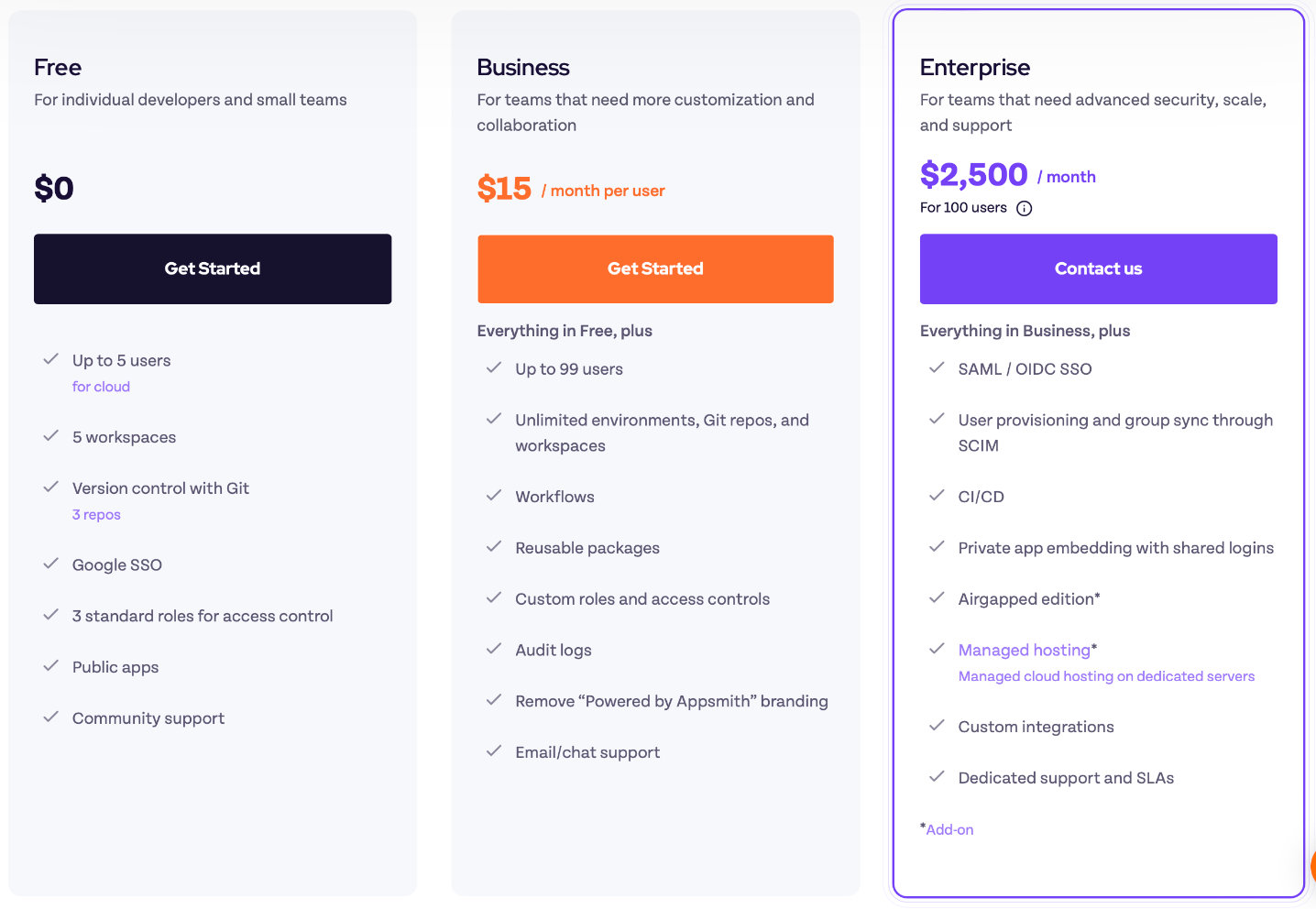
Free plan
$0/month per any user.
Business plan
$15 per user/month.
Enterprise plan
$2.500 per month for 100 users.
Appsmith reviews
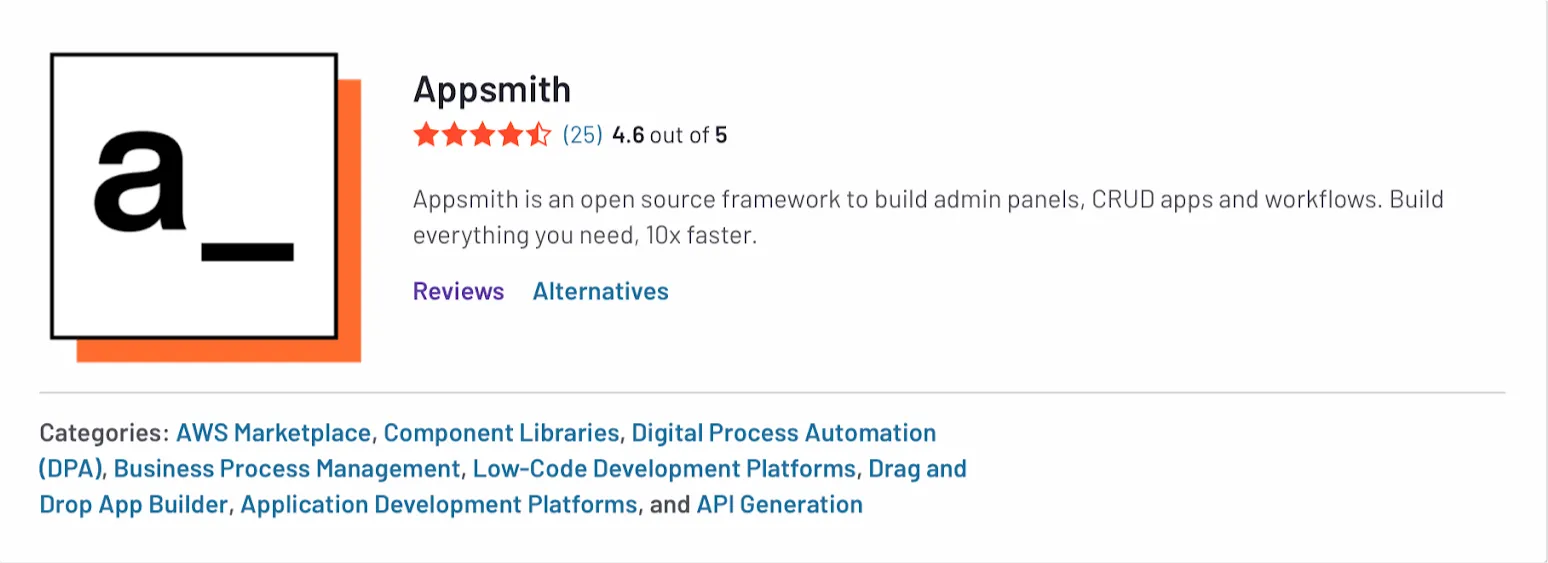
The rating for Appsmith is based on 25 reviews on G2.
Conclusion
Appsmith can serve as a suitable replacement for Retool. However, if you require enterprise-level functionalities, it is advisable to reconsider.
UI Bakery
When searching for a high-quality alternative for Appsmith, UI Bakery emerges as the leading competitor. While it shares numerous functions with Appsmith, UI Bakery distinguishes itself by providing extra features that enhance the efficiency of low-code web app development, resulting in a quicker and more straightforward process.
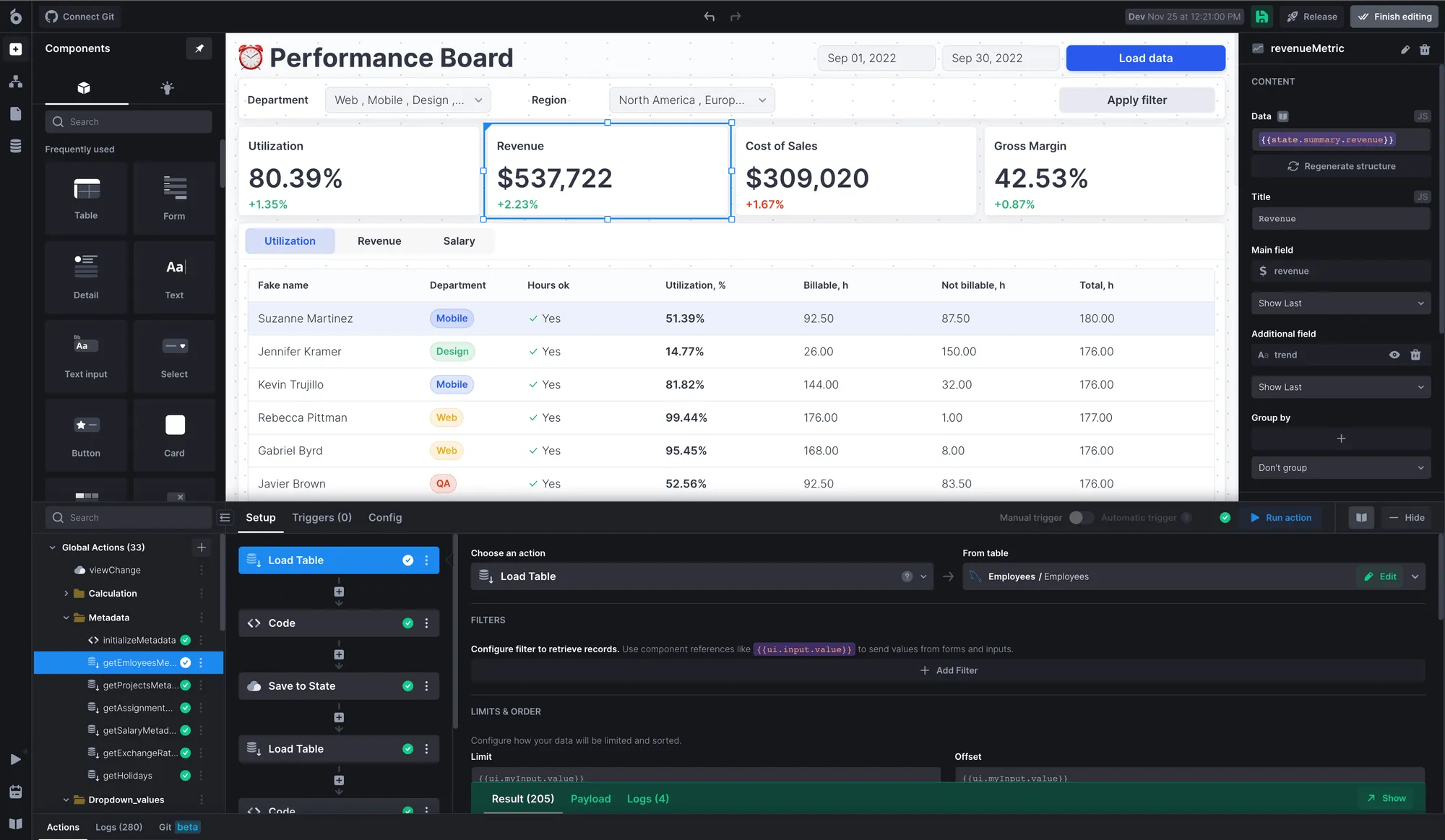
Smooth development experience and performance of drag’n’drop builder.
Workflow Automations allows to run scheduled jobs and web hooks.
- Larger widget library (75 currently available).
Larger integrations library (35 currently available).
Visual way of building business logic with the ability to add multiple action steps within a single action.
UI Bakery Database - store data directly in the platform.
Integrations with external analytics and logging solutions.
Fair pricing model, that allows a fixed price for potentially unlimited number of users.
Not open-source. As a result UI Bakery community is not as big.native data source connections, though has all most commonly used.
No autolayout feature. Though UI Bakery allows manual more fine-tuned approach for positioning of components when build responsive apps.
No Git integration on Free plan.
UI Bakery benefits
Attractive pricing
UI Bakery distinguishes itself with its reasonable pricing model that features Shared Permission Groups (potential unlimited number of users for a fixed fee), providing robust features at a cost lower than some competitors. This positions it as a cost-effective solution for businesses, especially those prioritizing high quality at an affordable price.
Responsive support
Users of UI Bakery benefit from prompt and efficient customer support, ensuring quick issue resolution and smooth development workflows.
Sleek UI component design
UI Bakery's component design receives consistent praise for its sleek and contemporary look among low-code applications. While design preferences are subjective, UI Bakery ensures visually appealing end-user interfaces with high-quality components, contributing to an enhanced user experience.
Efficient building experience
UI Bakery offers a seamless building experience with a user-friendly approach. The drag-and-drop functionality allows users to easily assemble components within a layout system based on columns, streamlining the development process and enhancing overall efficiency.
Comprehensive Roles management
UI Bakery provides thorough roles management, offering three predefined roles (admin, editor, user) as standard options. Users can also create additional roles with finely tuned access to data sources and applications. Custom roles, available in the Business plan, offer even greater flexibility in tailoring access controls.
Mobile responsiveness
UI Bakery excels in mobile responsiveness with granular settings, allowing developers to optimize and customize the mobile experience. This ensures that applications built with UI Bakery deliver a seamless and user-friendly interface across various devices.
AI Assistant
UI Bakery leverages AI capabilities not only for code generation but also for code debugging, and new user onboarding through an AI Assistant. This advanced feature enhances the development process, providing intelligent support to developers during the interface development phase.
Shared Permission Groups
UI Bakery's Shared Permission Groups contribute to its cost-effectiveness for large teams, streamlining permission management and making collaboration more efficient while maintaining control over access levels.
UI Bakery pricing
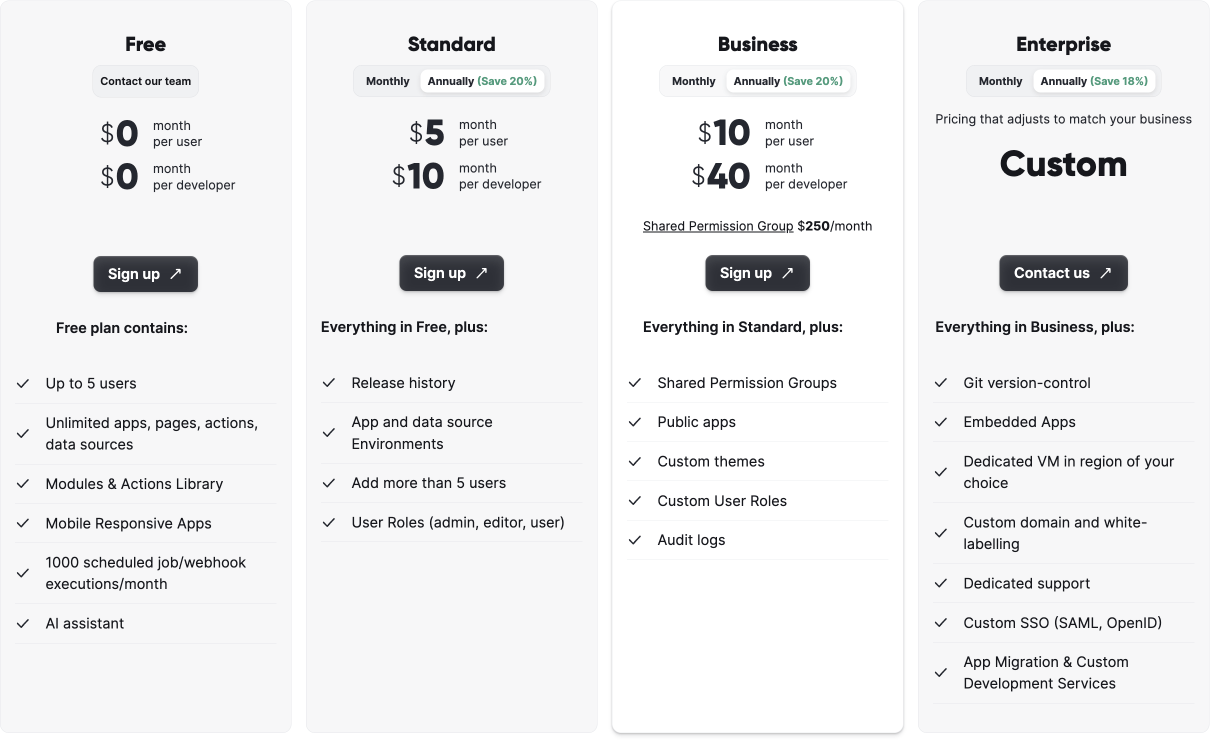
Free plan
$0 / month per user
Standard plan
$6 / month per user (monthly billing)
$12 / month per developer (monthly billing)
Business plan
$12 / month per user (monthly billing)
$50 / month per developer (monthly billing)
Shared Permission Group (unlimited users) - $300/month
Enterprise plan
Prices are tailored specifically to your organization needs.
UI Bakery reviews
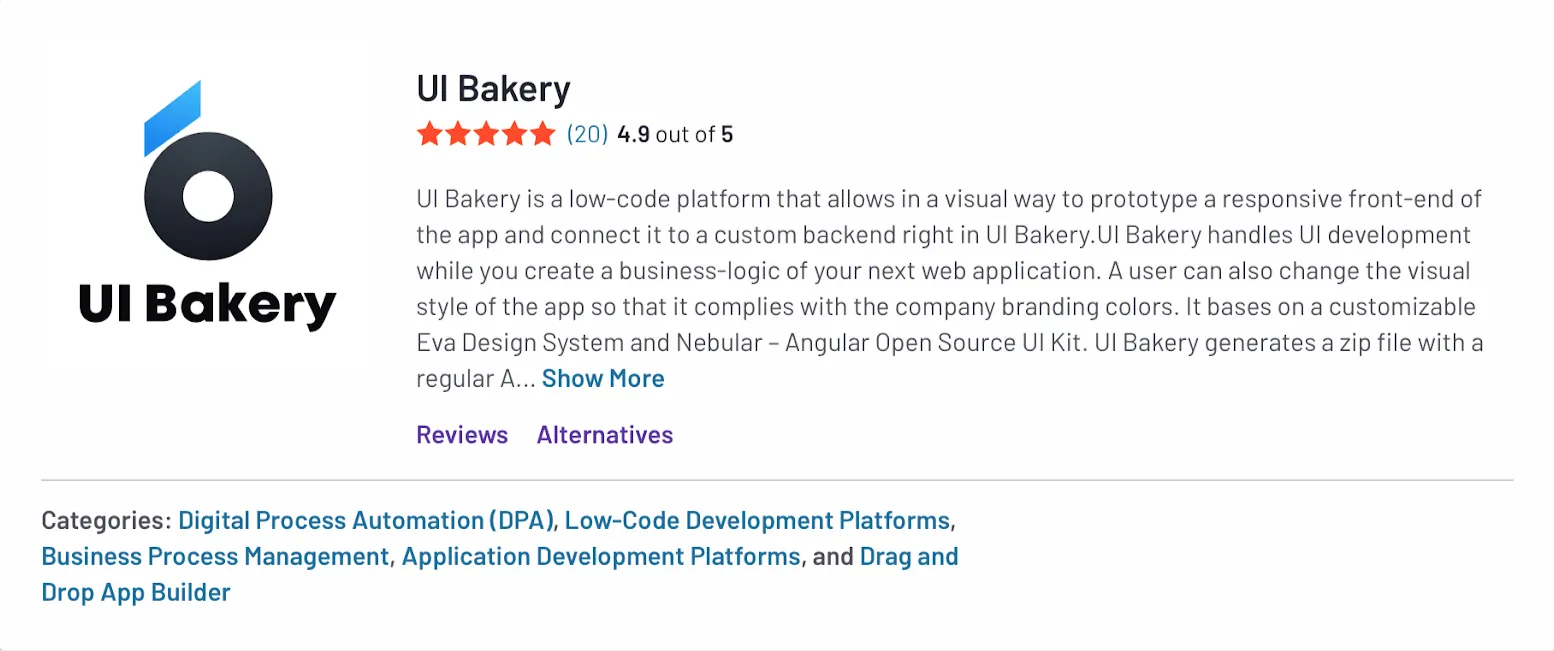
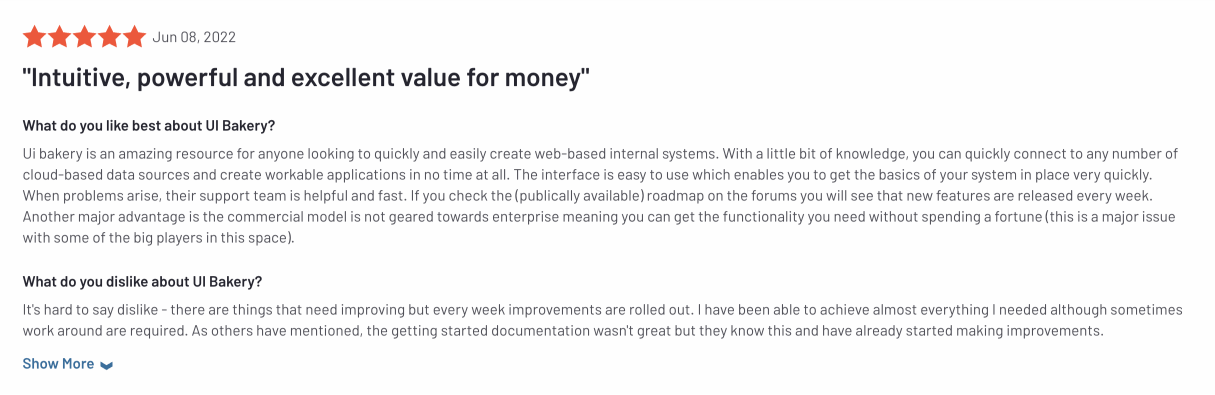
The rating for UI Bakery is based on 20 reviews on G2.
Highly customizable
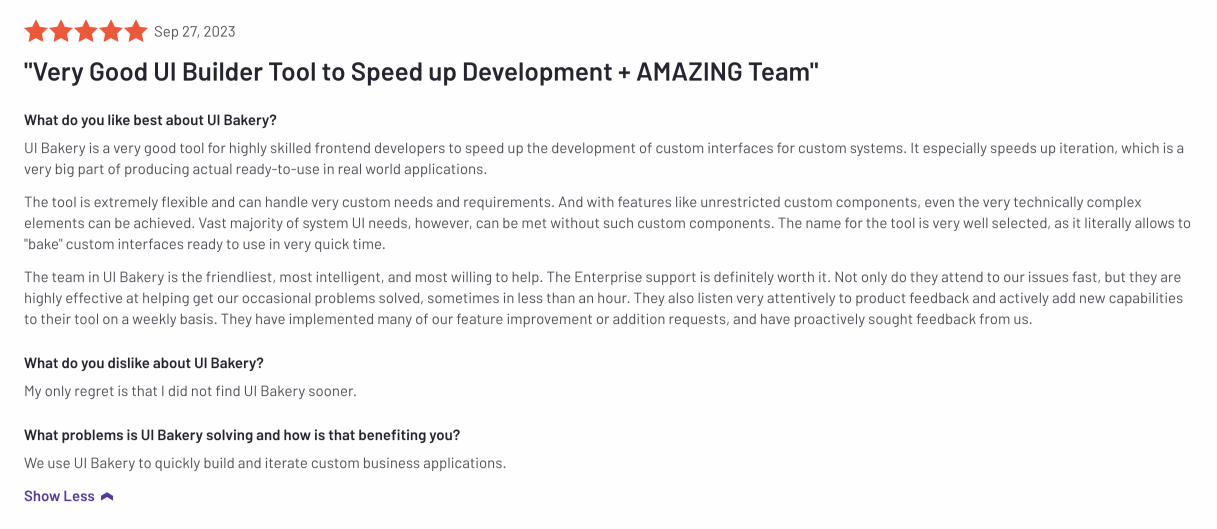
https://www.g2.com/products/ui-bakery/reviews/ui-bakery-review-8666649
Easy to work with
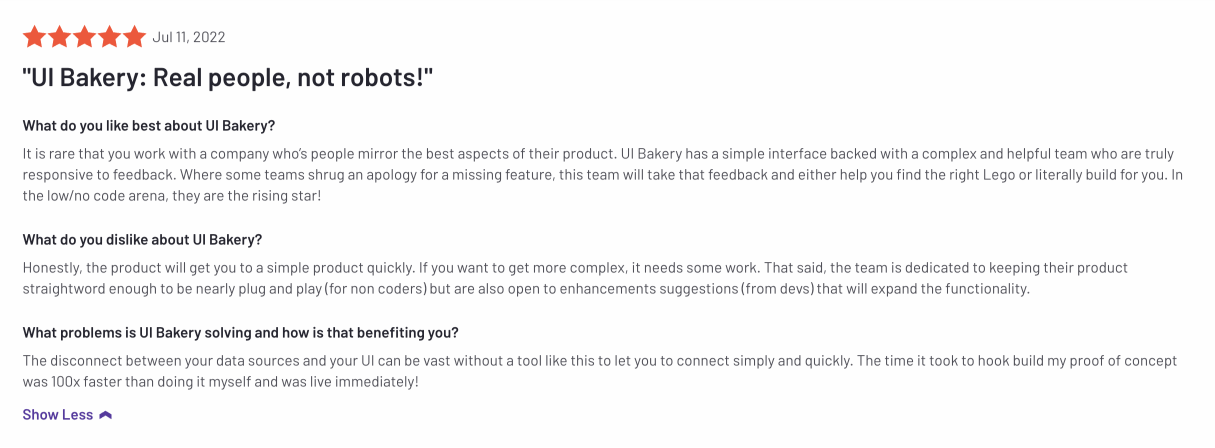
https://www.g2.com/products/ui-bakery/reviews/ui-bakery-review-6835170
Great pricing
https://www.g2.com/products/ui-bakery/reviews/ui-bakery-review-6715080
Conclusion
UI Bakery proves to be a viable alternative to Appsmith, especially for small and medium-sized businesses requiring enterprise-grade features like advanced roles and permissions and SSO but facing budget constraints or a steep learning curve with other platforms. It stands out as an excellent option for SMBs and SMEs aiming to develop internal tools.
Retool
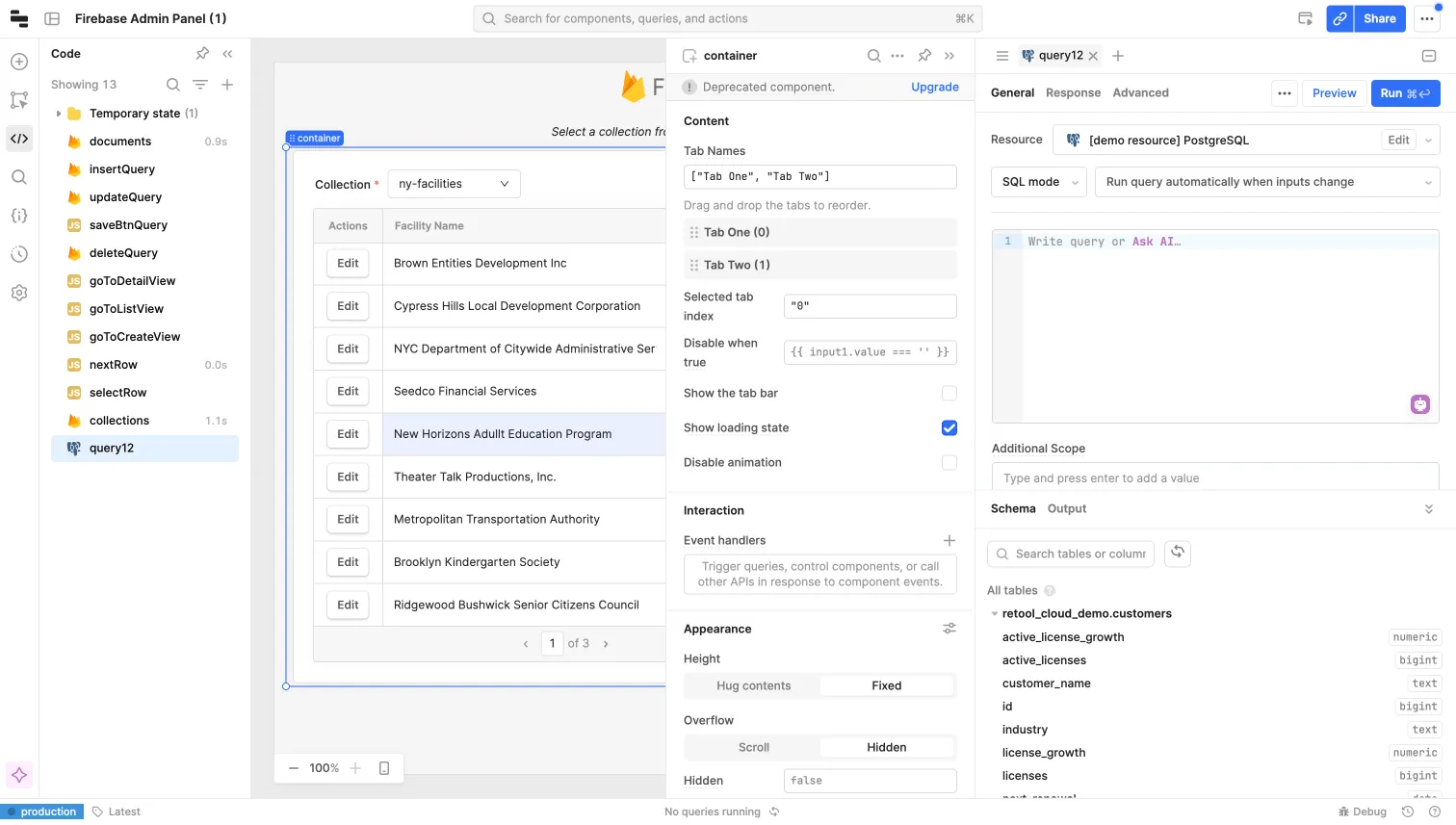
Boasting quite an extensive array of features, Retool proves to be an outstanding platform for constructing internal tools, making it a choice for large enterprises. Its diverse features, interconnected data sources, and quality place it among the top contenders in the market.
Many features allow to scale internal tool development for large enterprises.
A lot of components and data sources available.
Embedded Database.
Native mobile applications support.
Workflows/Automations allow to run scheduled jobs and web hooks.
Retool file storage support.
Enterprise plan is pretty costly.
Unpredictable per user pricing, that scales too quickly as you add more users. No alternative pricing approach.
Large applications are hard to maintain and have worse performance because of lack of the ability to add pages to the apps.
No ability to define multiple action steps in Retool apps. Only possible to achieve that with custom code.
Cloud instance may have performance issues.
Retool pricing
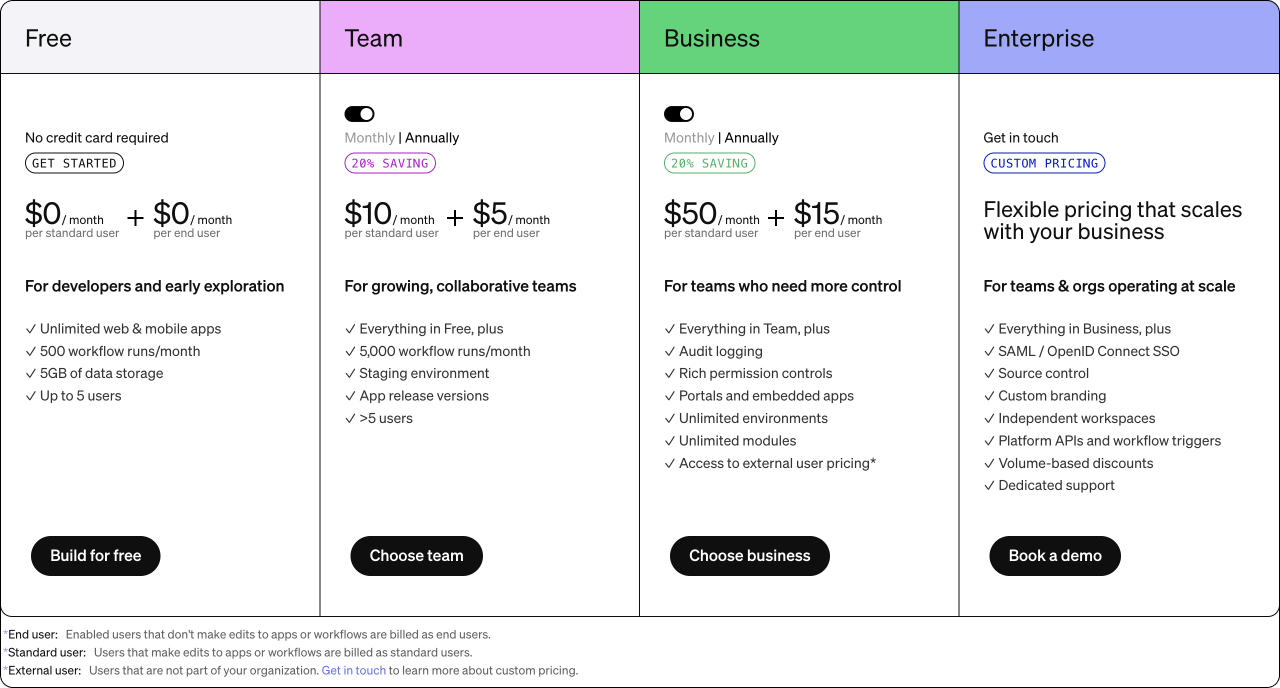
Free plan
$0/month per any user (limited features and up to 5 users)
Team plan
$12 / month per standard user (monthly billing)
$7 / month per end user (monthly billing)
Business plan
$65 / month per standard user (monthly billing)
$18 / month per end user (monthly billing)
Enterprise plan
Custom plan for teams & orgs operating at scale
Retool reviews
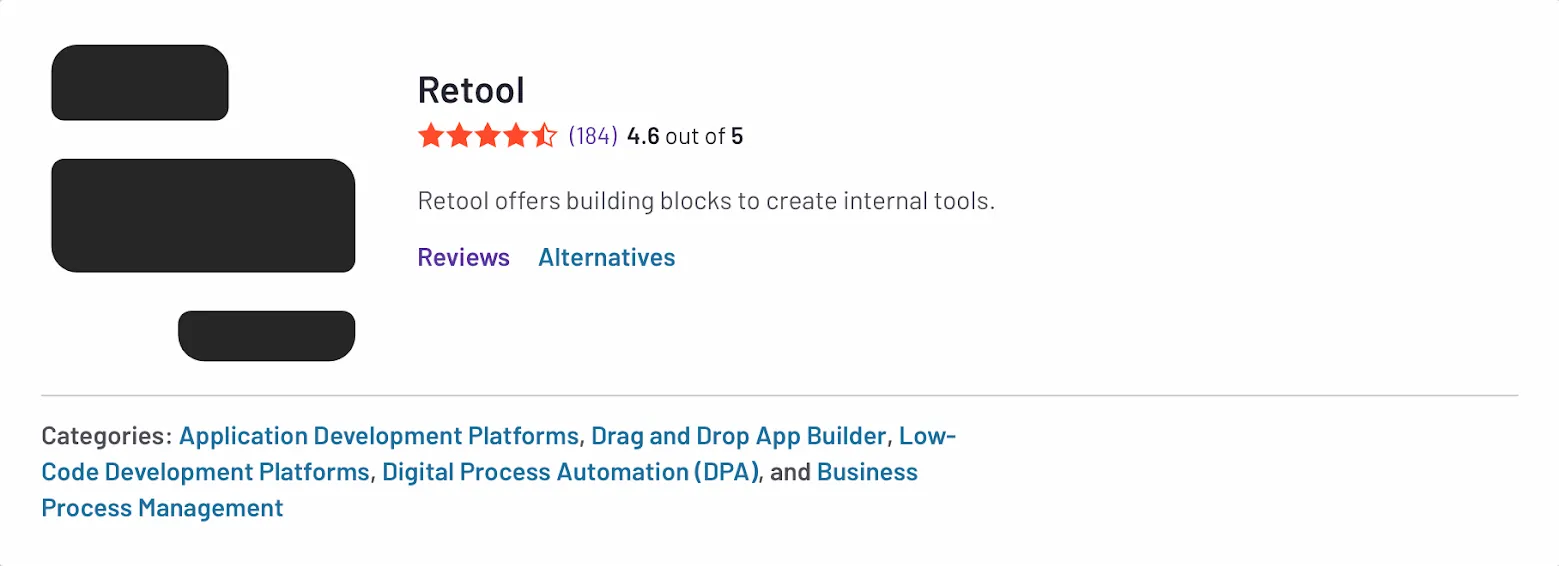
The rating for Retool is based on 184 reviews on G2.
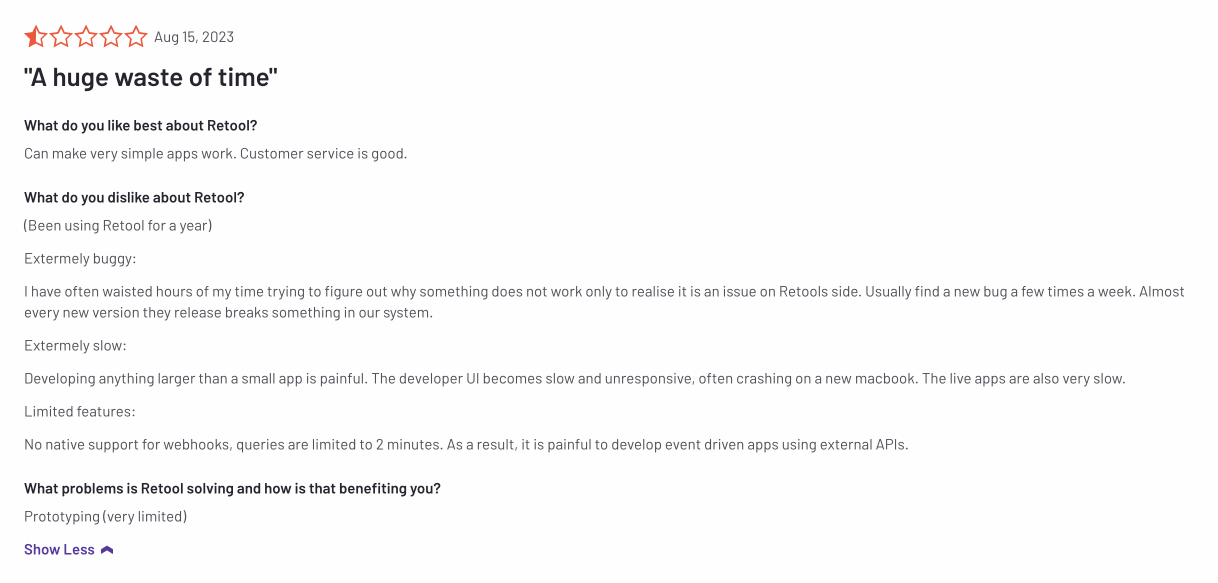
Bugs and errors
There is struggle with persistent bugs and errors in Retool, which creates a challenging environment for developing and maintaining applications. These issues significantly hinder workflow and productivity.
https://www.g2.com/products/retool/reviews/retool-review-8476483
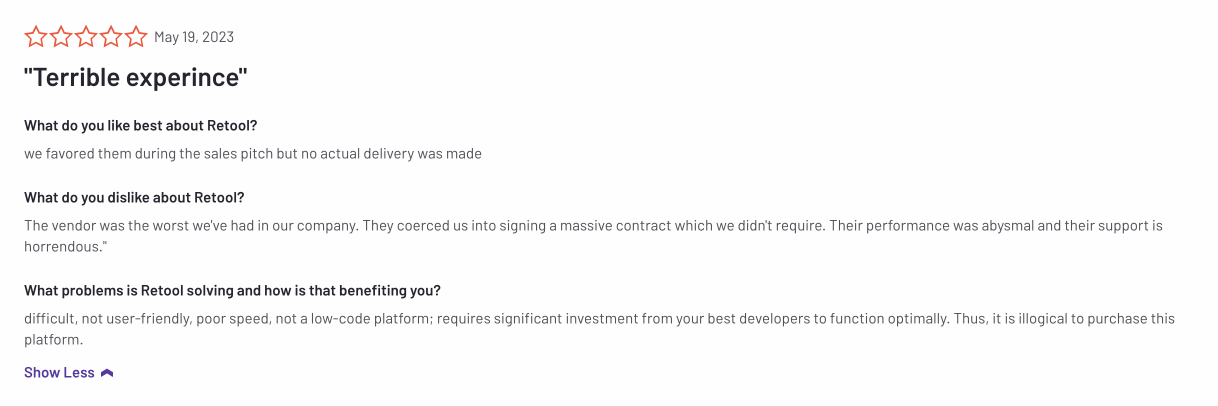
Limited customer support
People get a good vibe from Retool when they first hear the sales pitch, but then things go downhill once they're on board. There's talk about the company being pushy, getting folks to sign big contracts that they might not really need.
https://www.g2.com/products/retool/reviews/retool-review-8108949
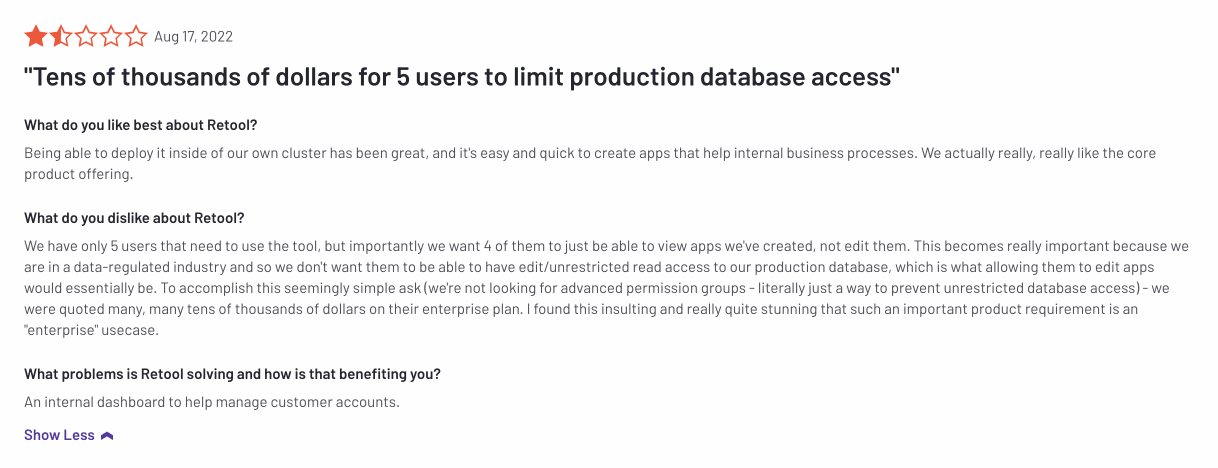
High price
Retool offers an expensive UI builder for limited features and users, which doesn't allow the companies to scale and grow their internal tools.
https://www.g2.com/products/retool/reviews/retool-review-6993790
Not scalable
People find Retool's UI easy to work with and like how they can stack components. But when things get complex, it seems the platform can get a bit glitchy. Also, the editor might slow down your computer because it's a bit of a memory hog.

https://www.g2.com/products/retool/reviews/retool-review-4548820
Conclusion
Retool proves to be a choice for businesses with larger budgets and significant demand for creating numerous internal tools. However, if your company's requirements are confined to just one or two apps that need to be shared among multiple users, Retool may not be the best Appsmith alternative for your needs.
Budibase
Budibase stands out as another low-code builder with distinctions in external and conceptual aspects compared to Appsmith. However, it does not closely compete with Appsmithl in terms of features.
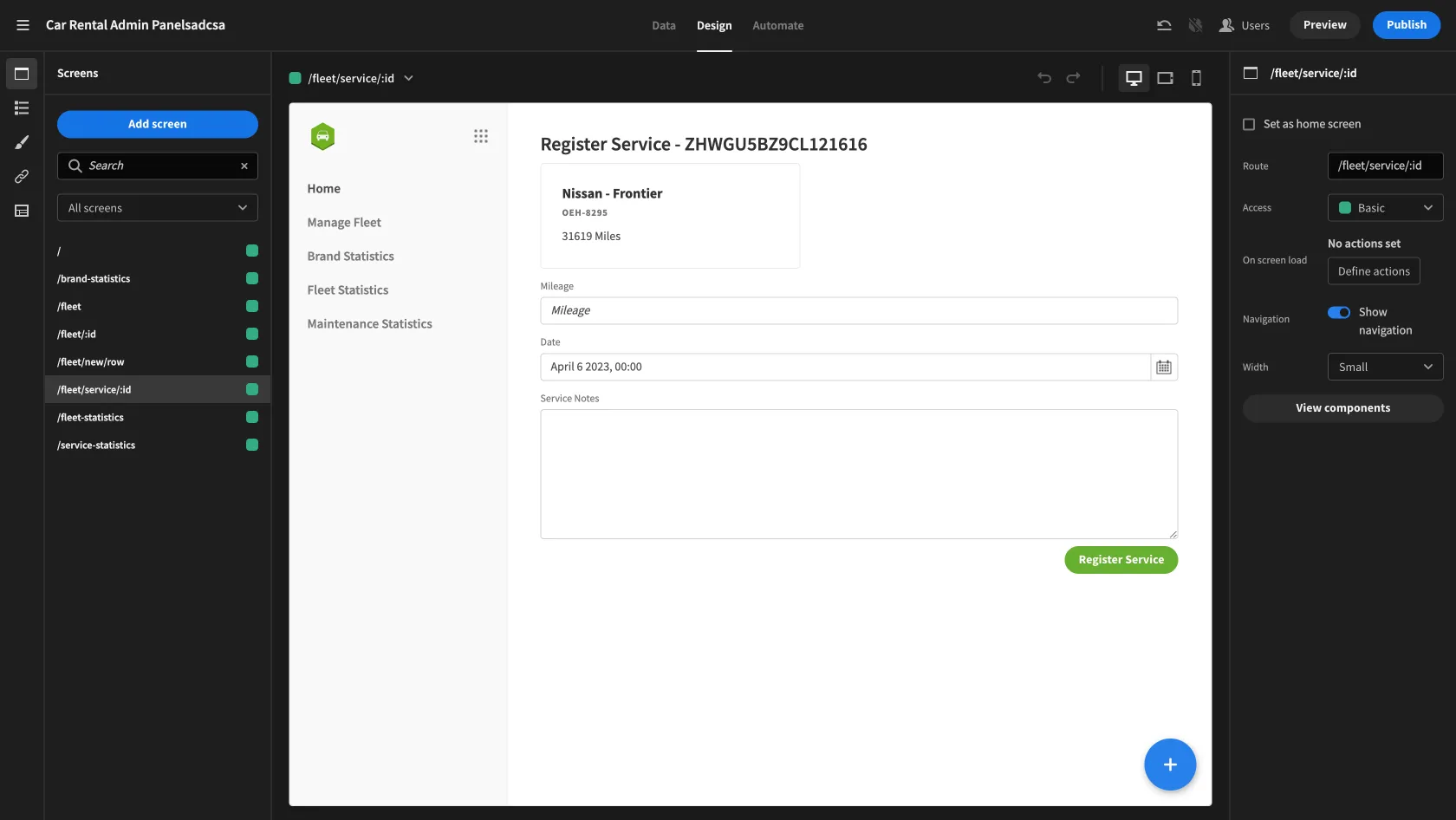
Implements some no-code concepts that allow people without coding skills to build internal apps.
Embedded Database.
Workflows/Automations available.
The application's pricing model is per user. While it is comparable than Appsmith’s, it might still be quite cost-inefficient for larger teams, especially with infrequent users. Moreover, there are several restrictions imposed on the number of logs, automations, and applications, which may add to the difficulty of calculating the overall pricing.
UI builder doesn’t have an absolutely positioned canvas for elements, which complicates the process of UI composition. Canvas is slow and has some bugs.
Requires learning additional concepts, e.g. data providers.
No Git integration.
No query/action performance information for debugging.
The system for creating queries and automations is not very user-friendly. They are jumbled and you have to work in a lot of narrow overlay windows.
Small amount of native data source connections.
Small amount of embedded components.
Budibase pricing
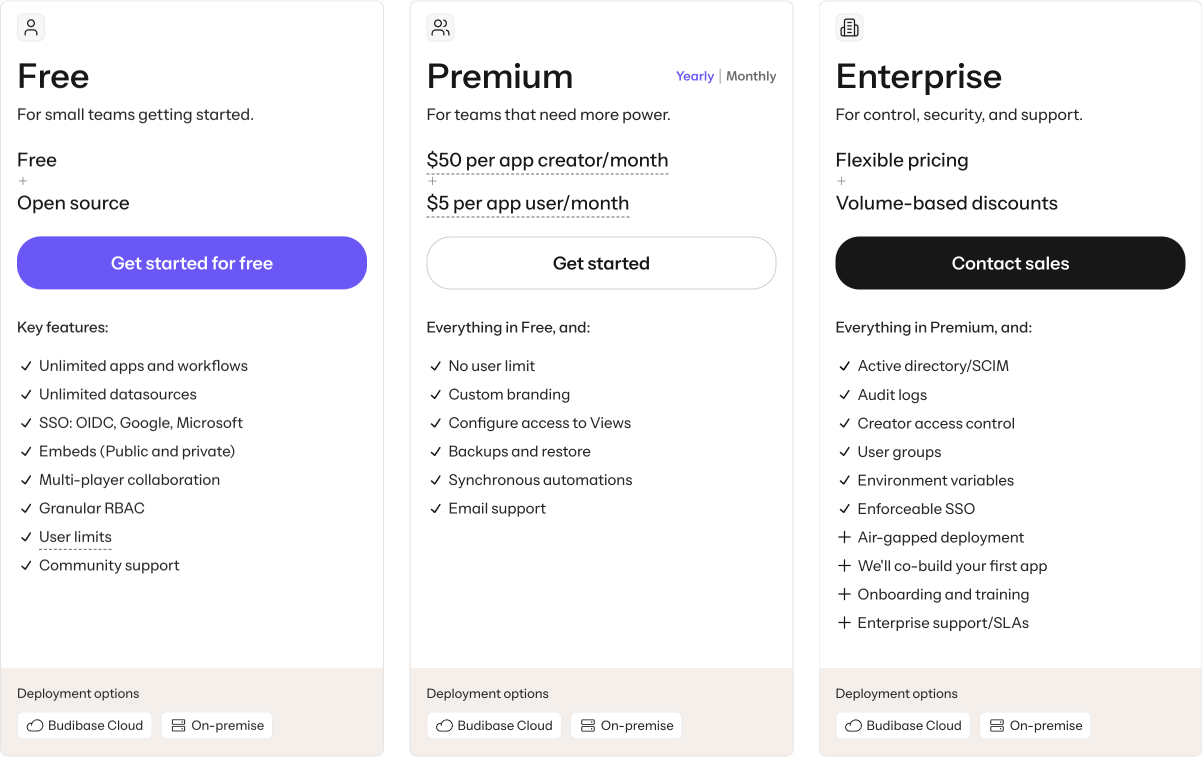
Free plan
$0 /month per user.
Premium plan
$60 per app creator/month.
$6 per app user/month.
Enterprise plan
Custom price for maxed up security and support.
Budibase reviews
Budibase lacks any type of reviews on G2.

Conclusion
Budibase is ideal for users with modest feature requirements or those who use such applications rarely. However, it comes with certain limitations, and the method of UI building may seem outdated when compared to competing platforms.
ToolJet
ToolJet presents itself as an open source Appsmith alternative. The platform has some similar features and concepts - with production issues but for free.
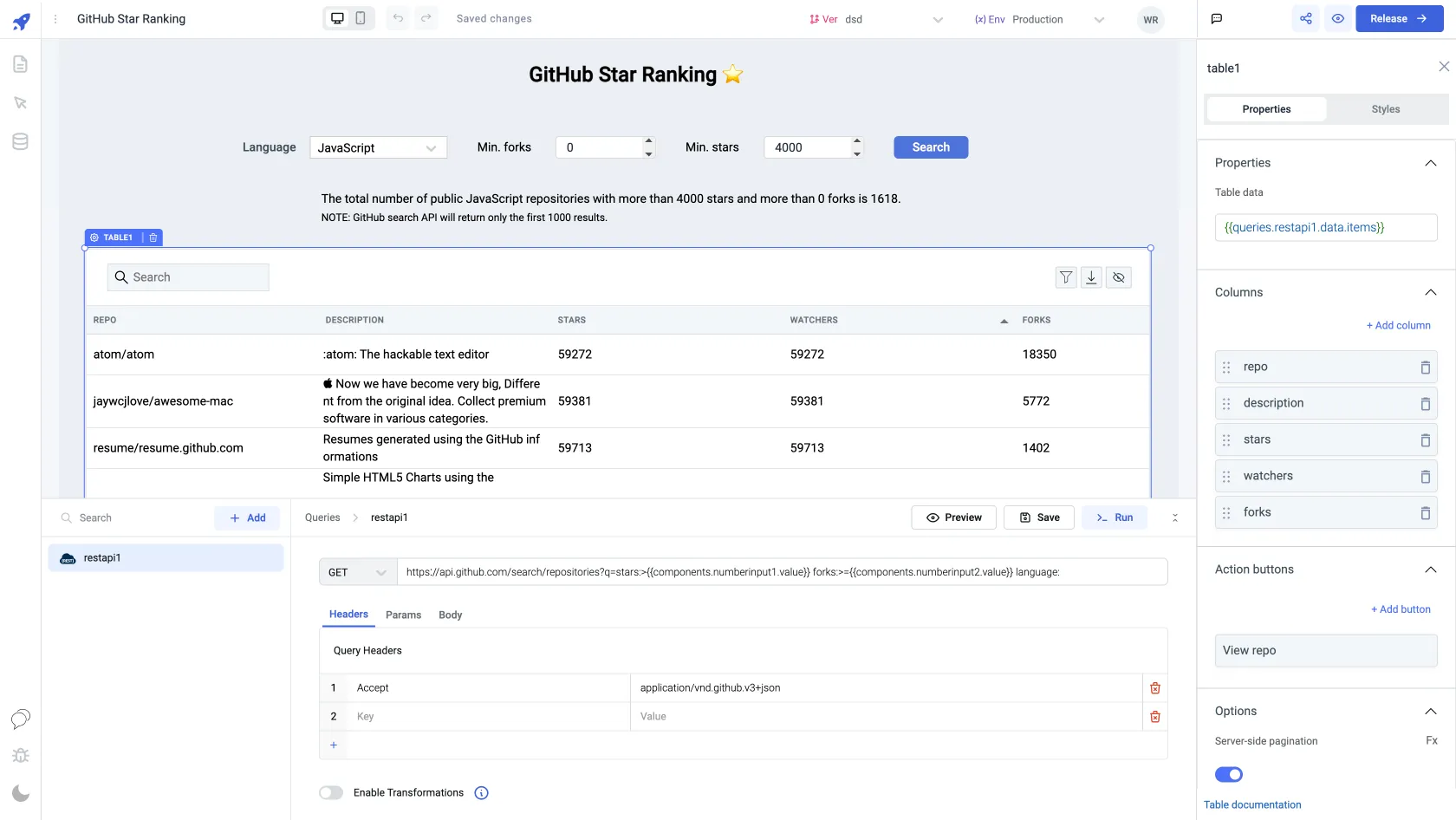
Includes a built-in database.
The software is open-source, allowing developers to review and inspect the code they use.
Offers a free version that users can manage on their own servers.
Provides a user interface design tool with both light and dark themes.
The interface for designing user interfaces is prone to glitches, including overlapping elements.
While it supports a variety of components and connections to data sources, there's limited ability to customize them.
The feature for syncing with Git does not support multiple branches.
Lacks tools for monitoring the efficiency of database queries or actions.
The tool for creating applications can be difficult to use due to quality issues.
Does not offer a feature for creating automated workflows or processes for public use.
ToolJet pricing
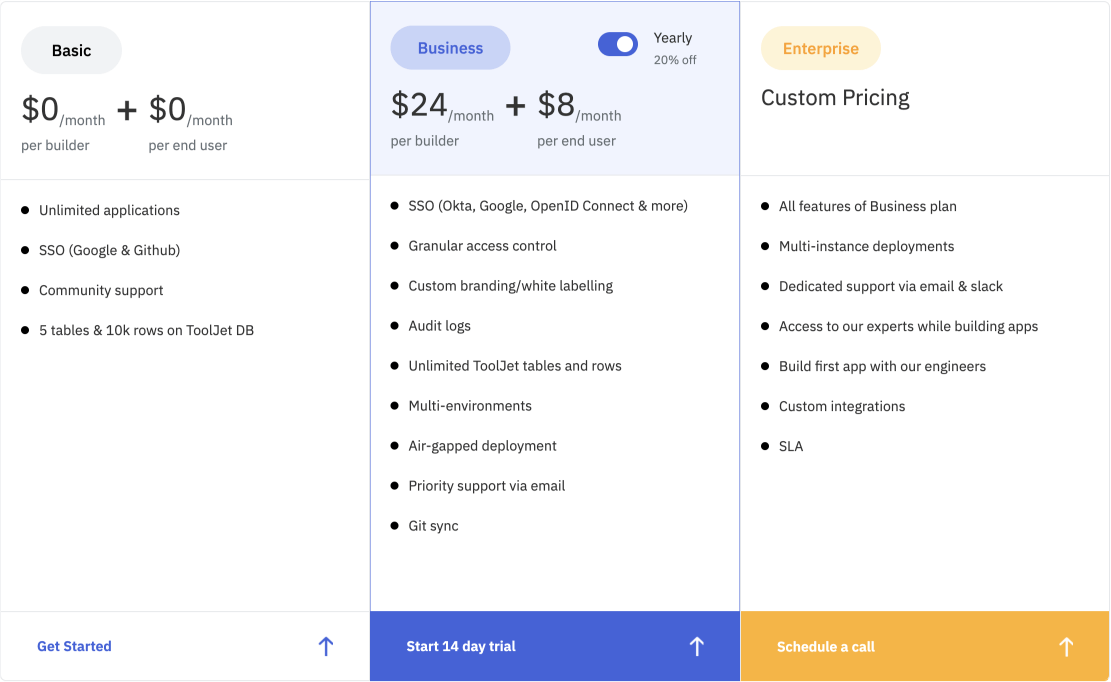
Basic plan
$0 /month per builder.
$0 /month per end user.
Business plan
$30 /month per builder (monthly billing).
$10 /month per end user (monthly billing).
Enterprise plan
Custom pricing that matches customer’s needs.
ToolJet reviews
The rating for ToolJet is based on 16 reviews on G2.
Conclusion
If you appreciate Appsmith open source approach but do not like their building experience, Tooljet might be a fitting choice. However, it appears that Tooljet has made limited progress in expanding its platform existing functionality in recent years. Furthermore, the platform has encountered various quality issues, potentially casting doubt on its appeal as a good alternative to Appsmith.
DronaHQ
With a substantial presence in the low-code and no-code domain, Drona has predominantly focused on providing a mobile-friendly experience. However, it is presently evolving into a more comprehensive platform with the capability to generate internal applications.
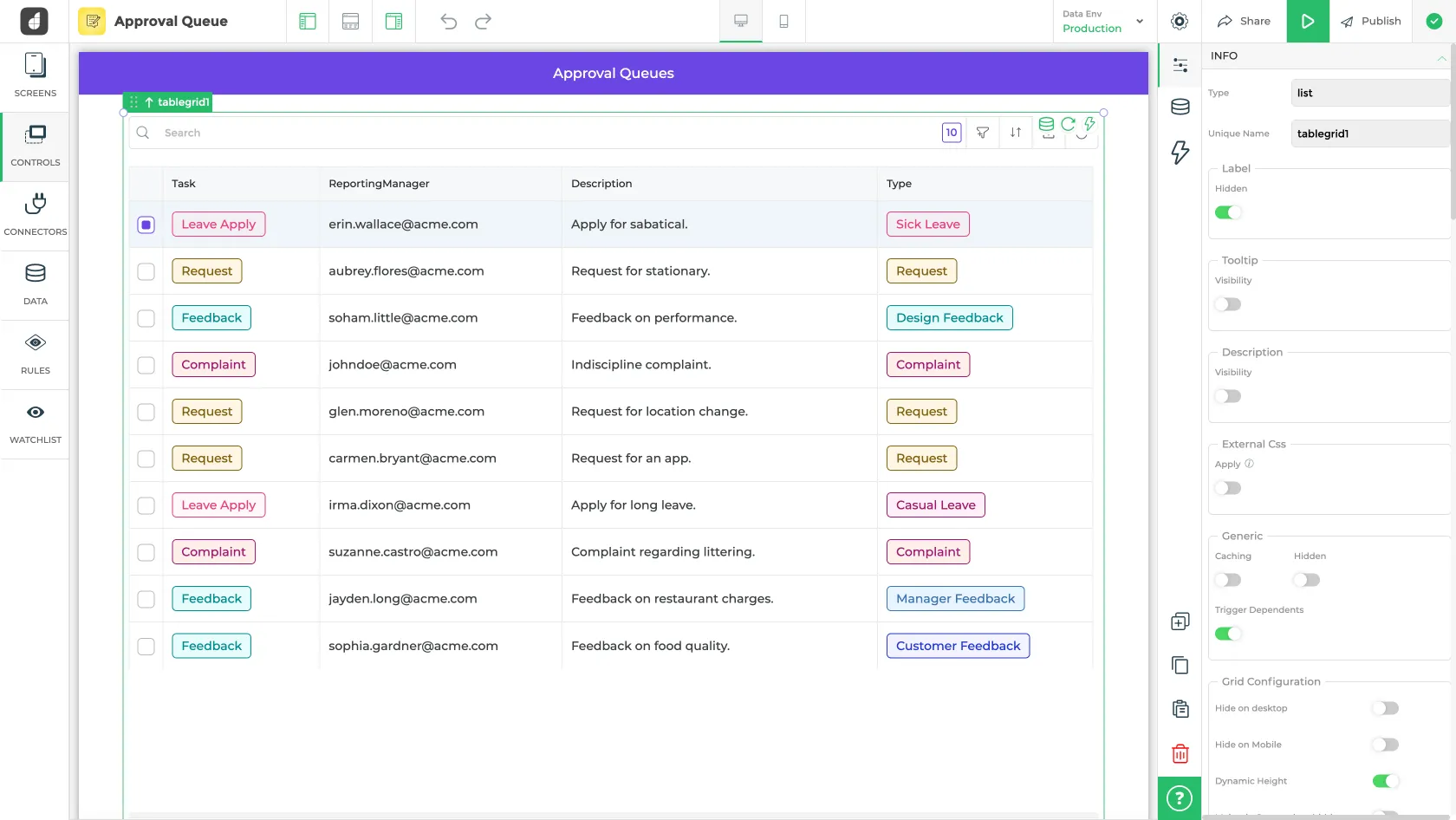
Offers the widest selection of connections to data sources and external services.
Has the most extensive collection of tools and elements for building applications.
Provides performance metrics for data connections.
Includes version control through Git.
Features capabilities for setting up scheduled jobs and webhooks.
Not open-sourced.
UI builder canvas has usability issues.
The user interface for the final product is bulky and can be overwhelming.
The design layout is often overcrowded and confusing, with too many minor sidebars and panels, making some options hard to find or organize.
Using the software on a cloud platform can result in slow performance.
The system for managing user permissions and access is less sophisticated compared to some other Appmith’s competitors.
Charges the same price for developers and end-users, which may not be cost-effective for organizations with many users.
DronaHQ pricing
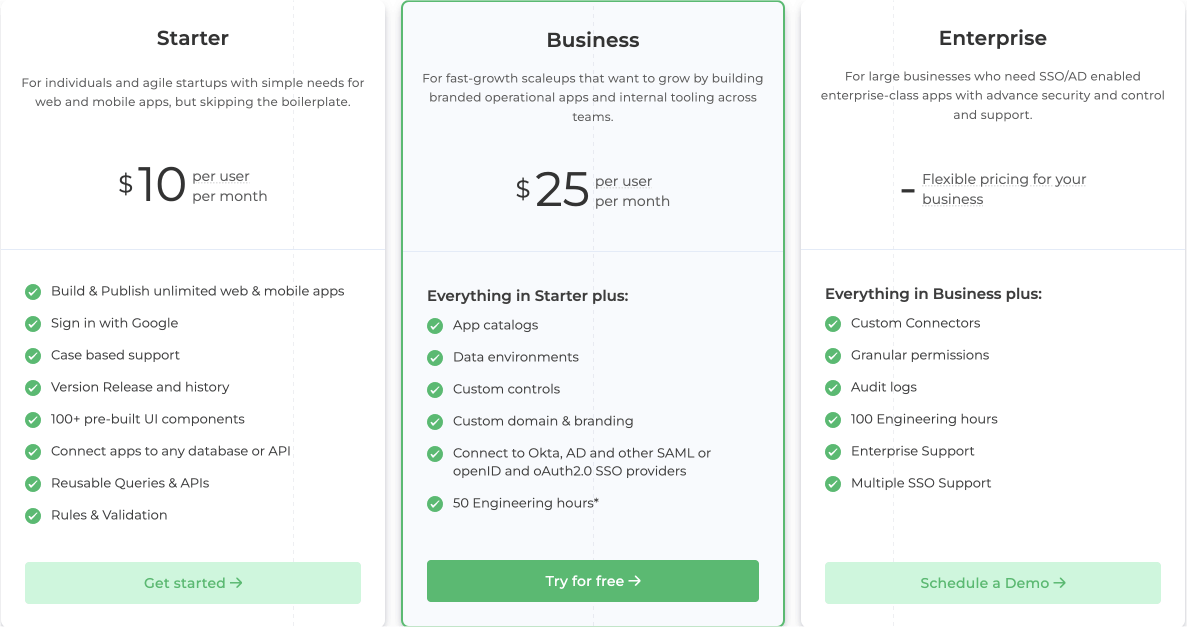
Starter plan
$12 per user monthly.
Business plan
$28 per user monthly.
Enterprise plan
Specialized price plans for large businesses.
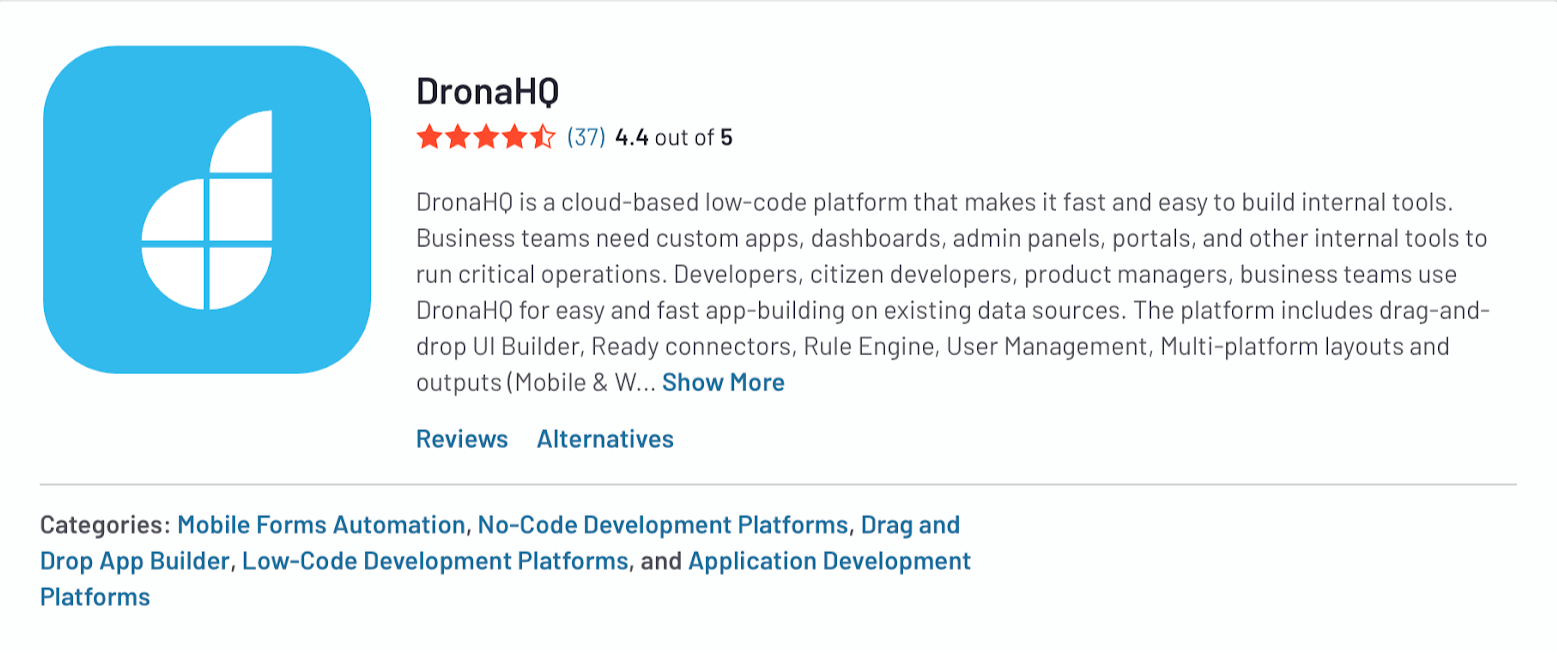
DronaHQ reviews
The rating for DronaHQ is based on 37 reviews on G2.
Long loading time and lack of support
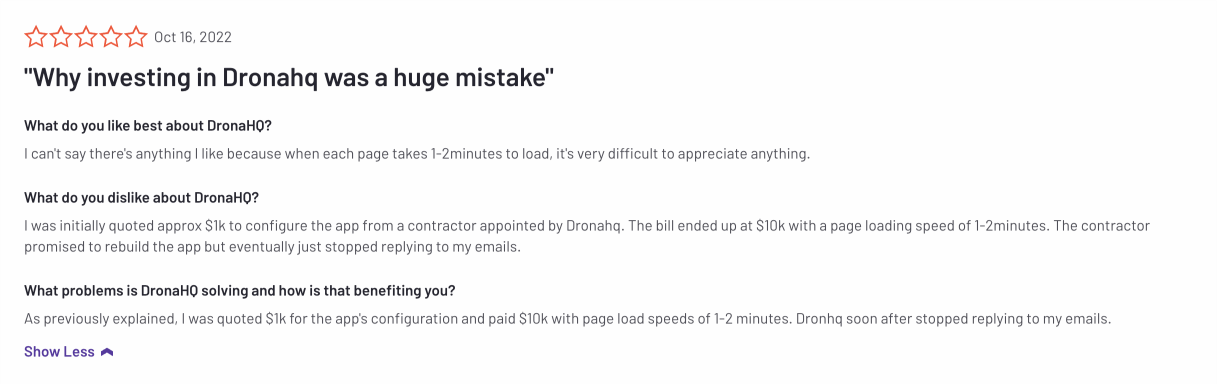
https://www.g2.com/products/dronahq/reviews/dronahq-review-7214715
Conclusion
DronaHQ has some issues with app quality and usability of the interface, even though it boasts an abundance of features, components, and data sources.
Superblocks
Superblocks stands as an enterprise-ready low-code platform designed for creating custom internal applications, automated workflows, and scheduled jobs. Developers can seamlessly extend Superblocks with code, ensuring delivery of high-performance apps at scale, and widespread adoption throughout their organization.
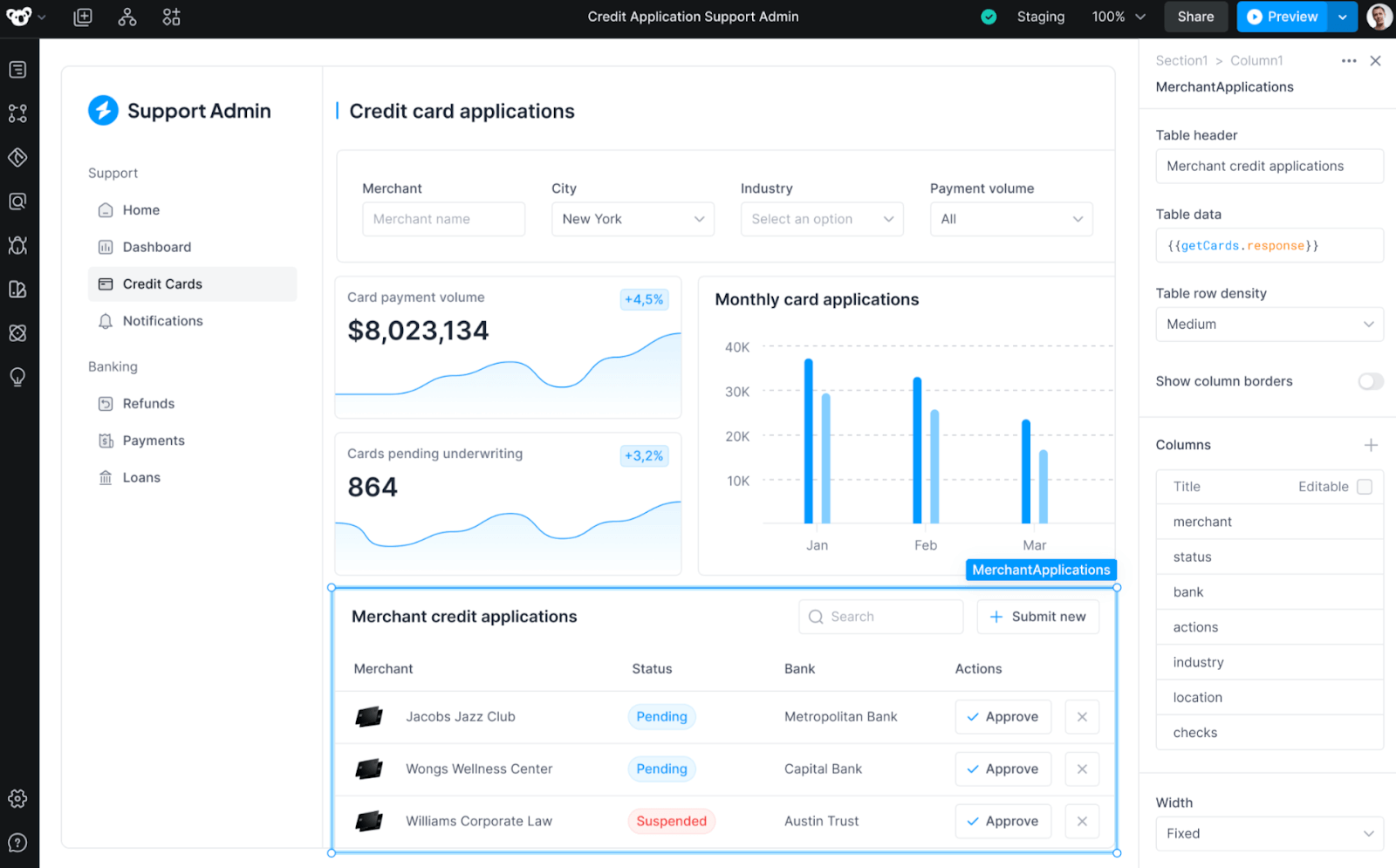
Supports creating complex server-side applications using NodeJS and Python, allows for front-end scripting with Javascript, and enables the development of custom React components within a dedicated development environment.
Utilizes multi-threading on the front end for seamless user interface experiences.
Can be deployed on-site with an On-Premise Agent or used online as a Cloud Application Builder.
Connects with monitoring tools such as Datadog, Splunk, and New Relic, and supports systems based on event-driven models like Kafka, Confluent, and Kinesis.
Offers a pricing model that scales with use.
Not open-sourced.
The library of available components is relatively small.
Lacks functionality for scheduling tasks or integrating webhooks.
Relatively new to the market, which may imply a lack of maturity or breadth of features found in longer-established platforms.
Does not offer support for creating responsive applications.
Provides only basic functionality for Git version control.
Does not offer airgapped deployments.
Superblocks pricing
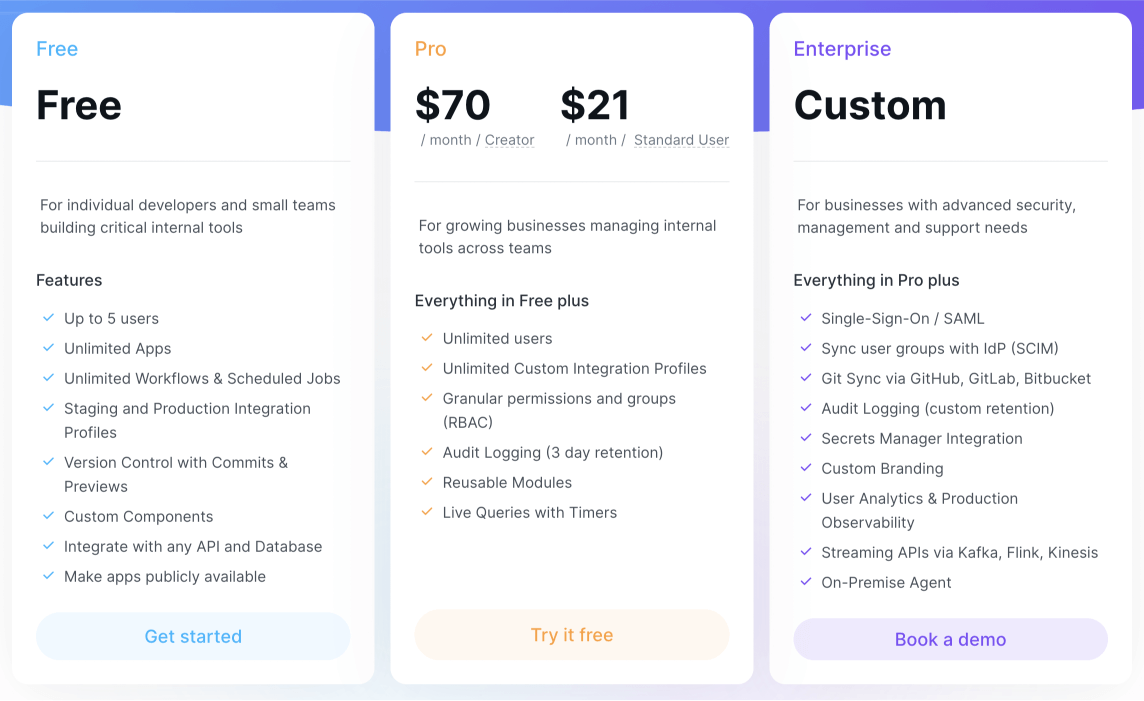
Free plan
$0 per user / monthPro.
Business plan
$70 Monthly Per Creator.
$21 Monthly Per User.
Enterprise plan
Custom Pricing Plan.
Superblocks reviews
The rating for Superblock is based on 58 reviews on G2.
Conclusion
Superblocks presents itself as a credible alternative for Appsmith, though with certain limitations and areas for improvement. Moreover, its status as a newcomer in the current market adds an additional aspect to consider.
Jet Admin
JetAdmin is another no-code builder for internal tools. Users can effortlessly craft internal tools without the need for coding on this platform to help their business.
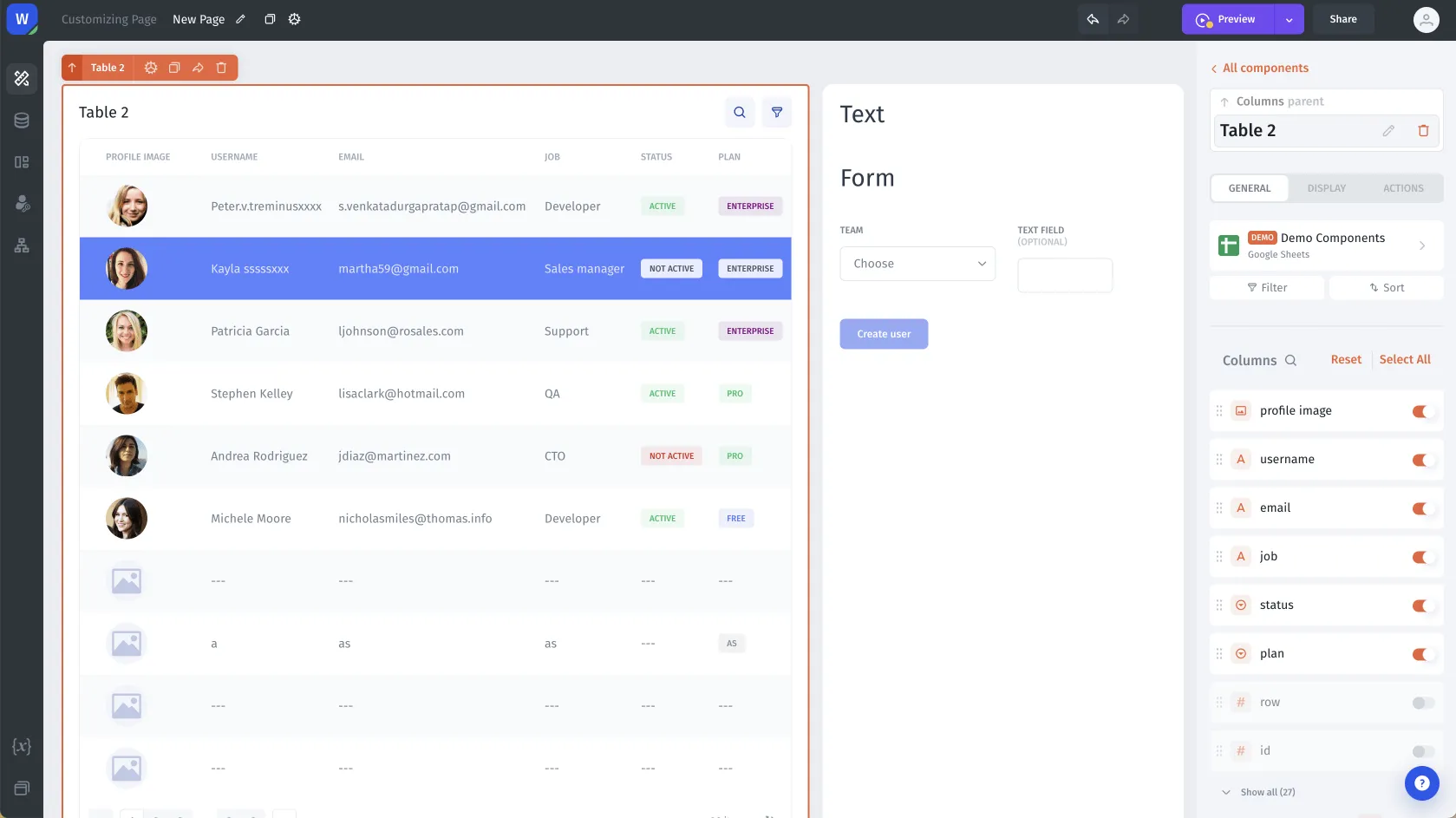
Allows for user interface creation without the need for programming knowledge, although a basic understanding of underlying concepts is beneficial.
Simplifies the process of developing applications that manage, create, read, update, and delete data (CRUD apps).
Includes features for setting up scheduled jobs and webhooks.
The user interface design is visually appealing, although it may be considered too bulky for professional business applications.
The simplicity of the no-code approach imposes significant restrictions on the complexity and functionality of the applications that can be created.
Uses a unique, vertically oriented and container-based method for arranging elements on the screen, which can be unusual compared to other no-code platforms.
Lacks integration with Git for version control, limiting collaboration and version tracking capabilities.
Does not provide insights into the performance of queries or actions, which can be crucial for troubleshooting and optimization.
The starting price for the basic subscription plan is relatively high, and costs can increase quickly as more applications and users are added, potentially making it an expensive solution for growing businesses.
Jet Admin pricing
Free plan
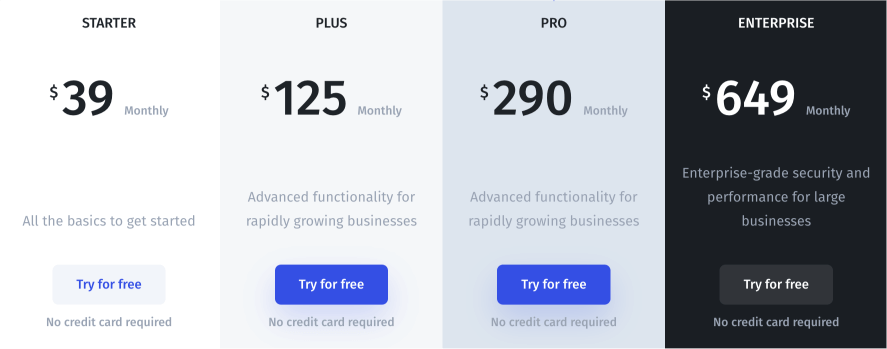
$0 per user / month.
Starter plan
$24 Monthly Per User.
Pro plan
$48 Monthly Per User.
Enterprise plan
Custom Pricing Plan.
Jet Admin reviews
The rating for Jet Admin is based on 6 reviews on G2.
Lack of customization
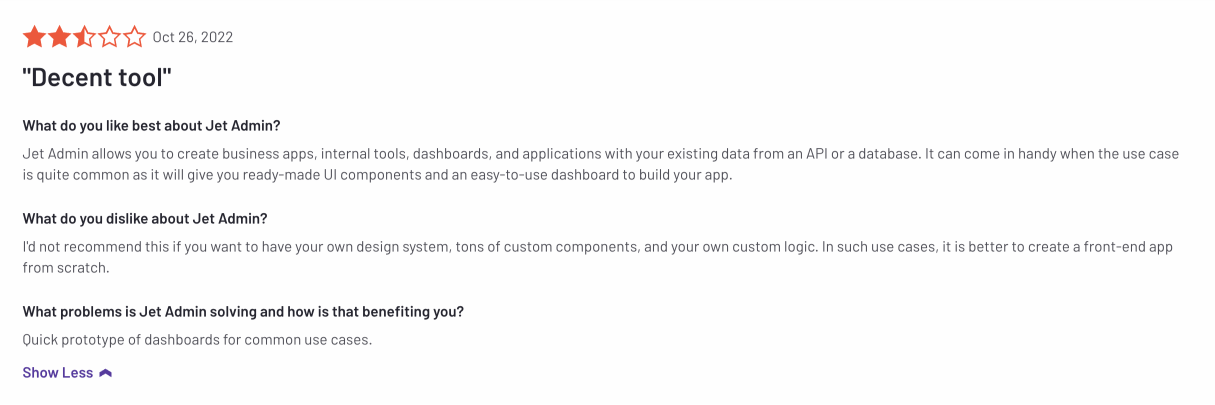
Despite the good basic features, users find that JetAdmin lacks customization for creating internal apps.
https://www.g2.com/products/jet-admin/reviews/jet-admin-review-7261699
Conclusion
Jet Amin could be an Appsmith alternative because it doesn't require coding. But remember, it might limit how much you can customize your apps. It's good for simple things like CRUD apps. However, it's expensive, and the price can go up unexpectedly.
Internal.io (shut down)
Regrettably, Internal.io is closing down. UI Bakery is here to help with a smooth transition or serve as a strong alternative for your internal application requirements.
Internal.io is a well-known name in the low-code tooling market, with a considerable presence in the industry. Their main goal is to empower people without coding skills to create secure internal applications.
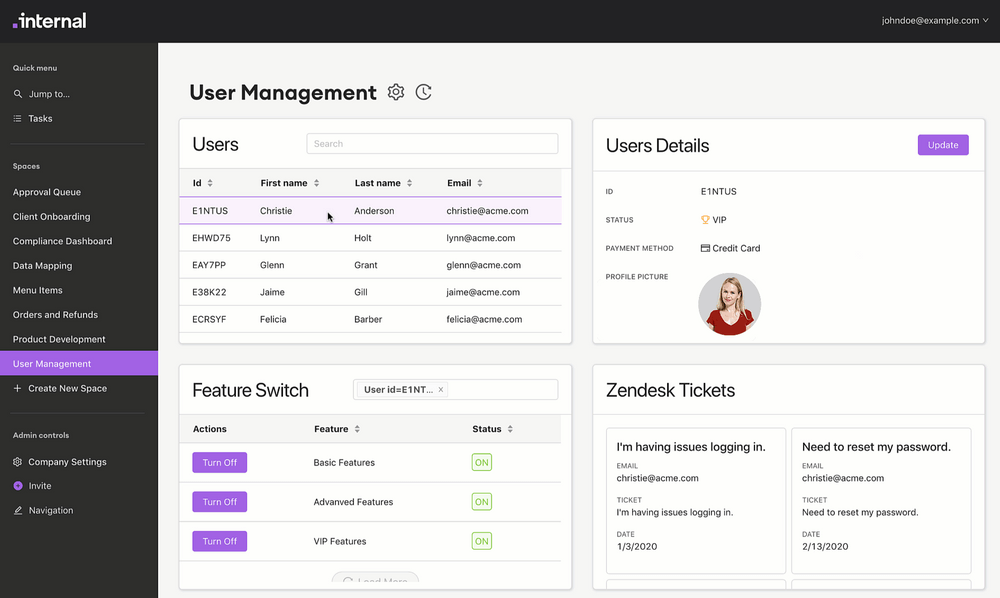
User interface creation is possible without programming expertise, though a basic understanding of key concepts is needed.
Simplifies the development of applications focused on database operations like creating, reading, updating, and deleting data.
Offers a more sophisticated system for managing user roles and permissions at lower price points compared to some other competitors.
Features Git integration for version control, enhancing collaboration and change management.
Supports automated processes and workflows, including the ability to automatically initiate workflows, known as pipelines.
The platform's no-code nature can significantly restrict the complexity and type of applications that can be built.
Offers a confusing array of subscription plans, making it challenging to select the most appropriate one.
The tool for designing user interfaces may experience issues with elements overlapping.
While the platform provides a variety of components and data sources, it has the fewest options compared to its competitors and often lacks advanced configuration options.
The user interface for the final product is bulky, with limited options for customization.
Lacks detailed analytics on the performance of database queries or actions, which can hinder troubleshooting and optimization efforts.
The interface for building queries and setting up automations can be difficult to navigate and use effectively.
Internal.io pricing
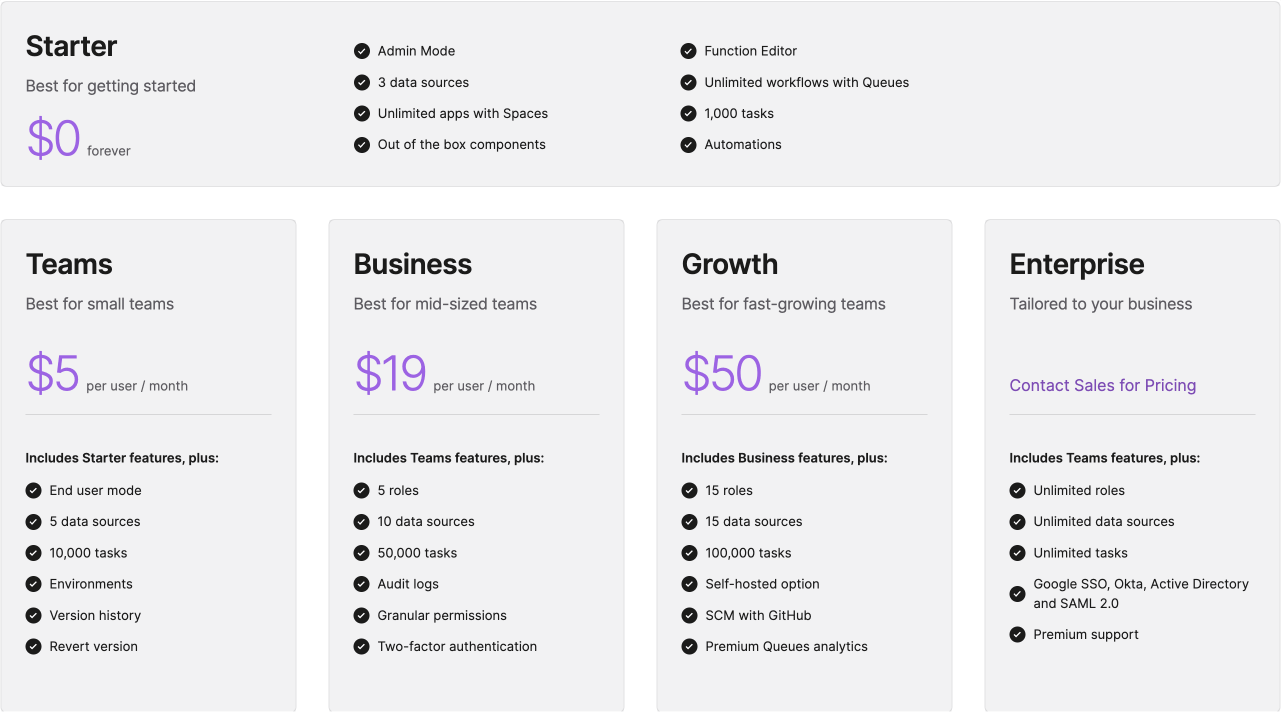
Starter plan
$0 per user / month.
Teams plan
$5 per user / month.
Business plan
$19 per user / month.
Growth plan
$50 - per user / month.
Enterprise plan
Pricing is tailored to specific business.
Conclusion
The diverse range of plans in the pricing structure allows businesses to choose the best option for their needs. However, it's crucial to understand that Internal.io’s no-code approach limits how much you can customize and extend the created applications.
Airplane.dev (shut down)
With the acquisition of Airplane.dev, UI Bakery is here to assist with smooth migration or serve as a strong alternative for continuous low-code development.
Airplane.dev grew in the internal tools space, providing a simplified solution for crafting UIs and workflow automations. Being a recent entrant to the internal tooling market, Airplane.dev concentrates on enabling developers to easily construct workflows and dashboards.
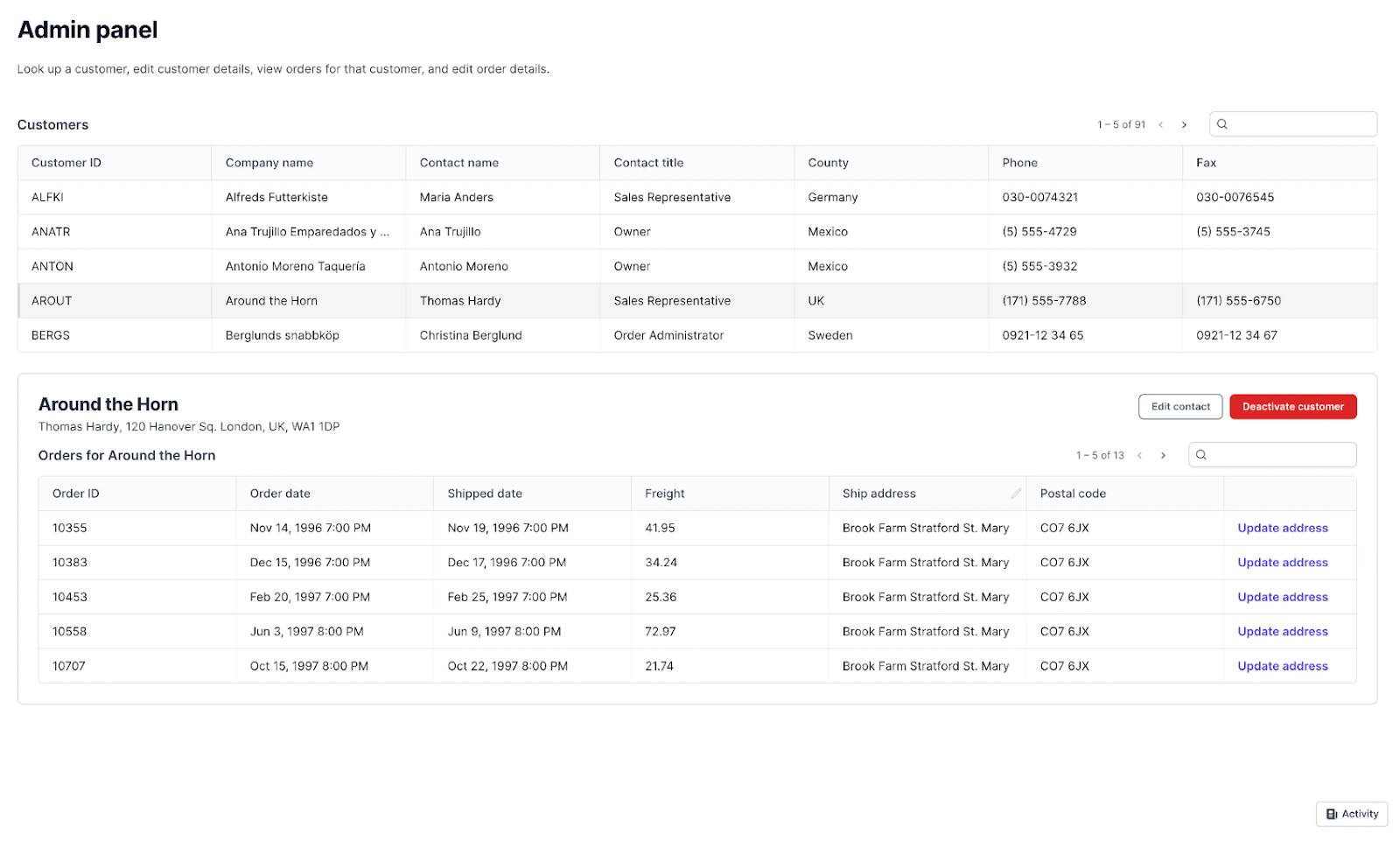
Enables the creation of tailored internal workflows and dashboards, specifically through the use of Tasks.
Offers intuitive workflows capable of running SQL, JavaScript, Python, or Docker commands, integrated with Views for a seamless experience.
Comes with a library of prebuilt components that require minimal coding to implement, simplifying development.
Features advanced capabilities for automating schedules and workflows, enhancing productivity over time.
The variety of prebuilt components available is relatively small, potentially limiting creativity or requiring more custom development.
Offers a limited selection of templates, which may hinder rapid development or the ease of getting started on common project types.
Subscription plans are on the higher end of the price spectrum, which could be prohibitive for smaller teams or startups.
Presents a challenging learning curve for those new to the platform, requiring time and effort to become proficient.
Airplane.dev pricing
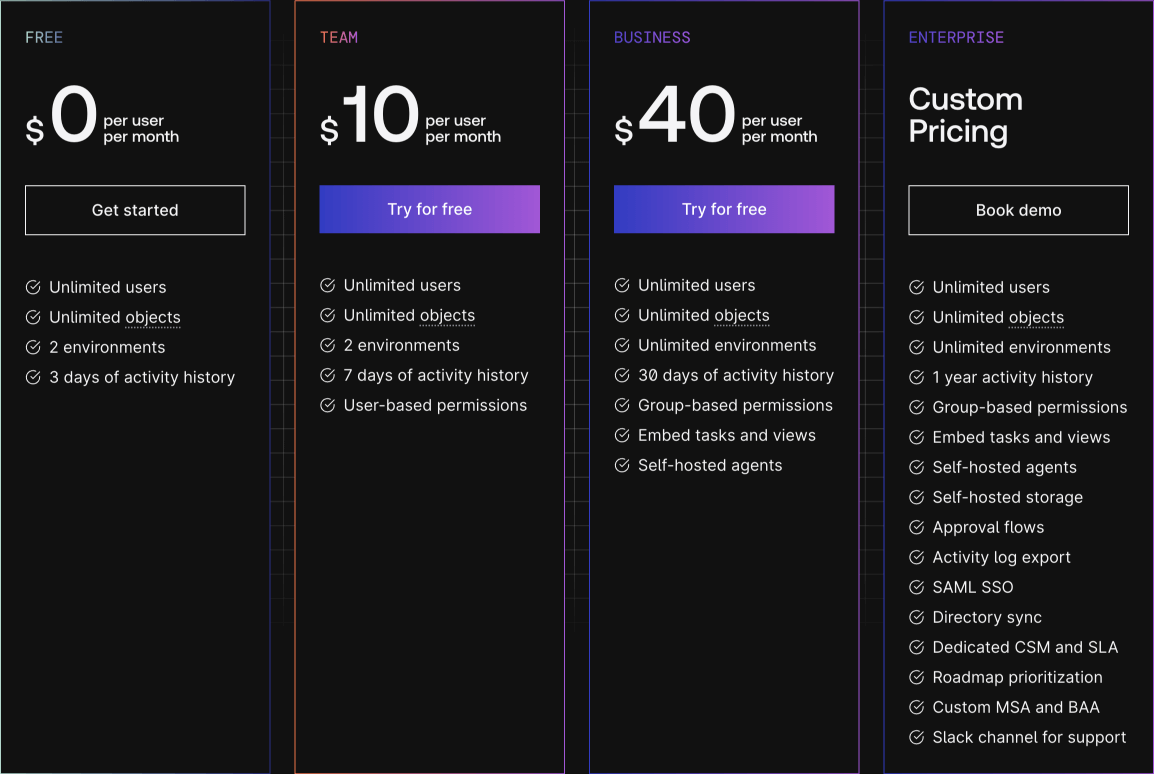
Free plan
$0 per user / month.
Teams plan
$10 per user / month.
Business plan
$40 per user / month.
Enterprise plan
Tailored pricing for specific business needs.
Conclusion
Airplane.dev offered solutions that meet various business needs, but users should be aware of limitations in component variety that might affect application customization. For simple use cases like admin panels or support ticket dashboards, Airplane.dev used to be a strong choice in the low-code space.
| Appsmith | UI Bakery | Retool | Budibase | DronaHQ | Superblocks | ToolJet | Jet Admin | |
|---|---|---|---|---|---|---|---|---|
| Pricing | ||||||||
Pricing | $$$From $0.40/hour/user | $$$From $10/month/developer From $5/month/user | $$$$$From $10/month/developer From $5/month/user | $$$$$$50/month/developer $5/month/user | $$$From $5/month/user | $$$$$From $49/month/developer From $15/month/user | $$$From $24/month/developer From $8/month/user | $$$$From $24/month/user |
Prycing type | per user per hour | per user | per user | per user | per user | per user | per user | per user |
Free plan | ||||||||
Self-hosted version | ||||||||
| General | ||||||||
Usability and quality |  | | | | | | | |
| Datasources | ||||||||
Databases | 10 | 16 | 22 | 12 | 22 | 15 | 19 | 9 |
HTTP API | ||||||||
GraphQL | ||||||||
3rd-party services | 9 | 19 | 24 | 2 | 41 | 36 | 19 | 20 |
Embedded DB | ||||||||
| UI building experience | ||||||||
Drag'n'Drop | Absolutely positioned canvas, no overlaps | Absolutely positioned canvas, no overlaps | Absolutely positioned canvas, no overlaps | Nested drop, configurable layout | Absolutely positioned canvas, PowerPoint-like overlaps | Absolutely positioned canvas, no overlaps | Absolutely positioned canvas, PowerPoint-like overlaps | Vertically stacked drag'n'drop |
Styling and white labelling | Both | Both | Both | Only styling | Both | Both | Both | Only styling |
Components | 45+ | 75+ | 110+ | 35+ | 110+ | 25+ | 40+ | 50+ |
Custom component | ||||||||
| Enterprise features | ||||||||
Custom roles & permissions | ||||||||
Workflows / Automations | ||||||||
Environments | ||||||||
Audit logs | ||||||||
SSO | ||||||||
Git synchronization | Sync only | |||||||
🏁 To sum up
Delving into alternatives to Appsmith unveiled a landscape where each solution has its unique strengths and weaknesses. The adaptability and effectiveness of low-code solutions make them an enticing option for diverse development requirements. Among these choices, UI Bakery stands out as the clear winner, combining user-friendly functionality with robust features to provide the most comprehensive solution in the market. Navigating through Appsmith's competitors can be a challenging task, given their varied offerings. UI Bakery is here to assist — feel free to reach out and talk to our tech experts for guidance.
